J.C Home Decor and Lighting Manufactory


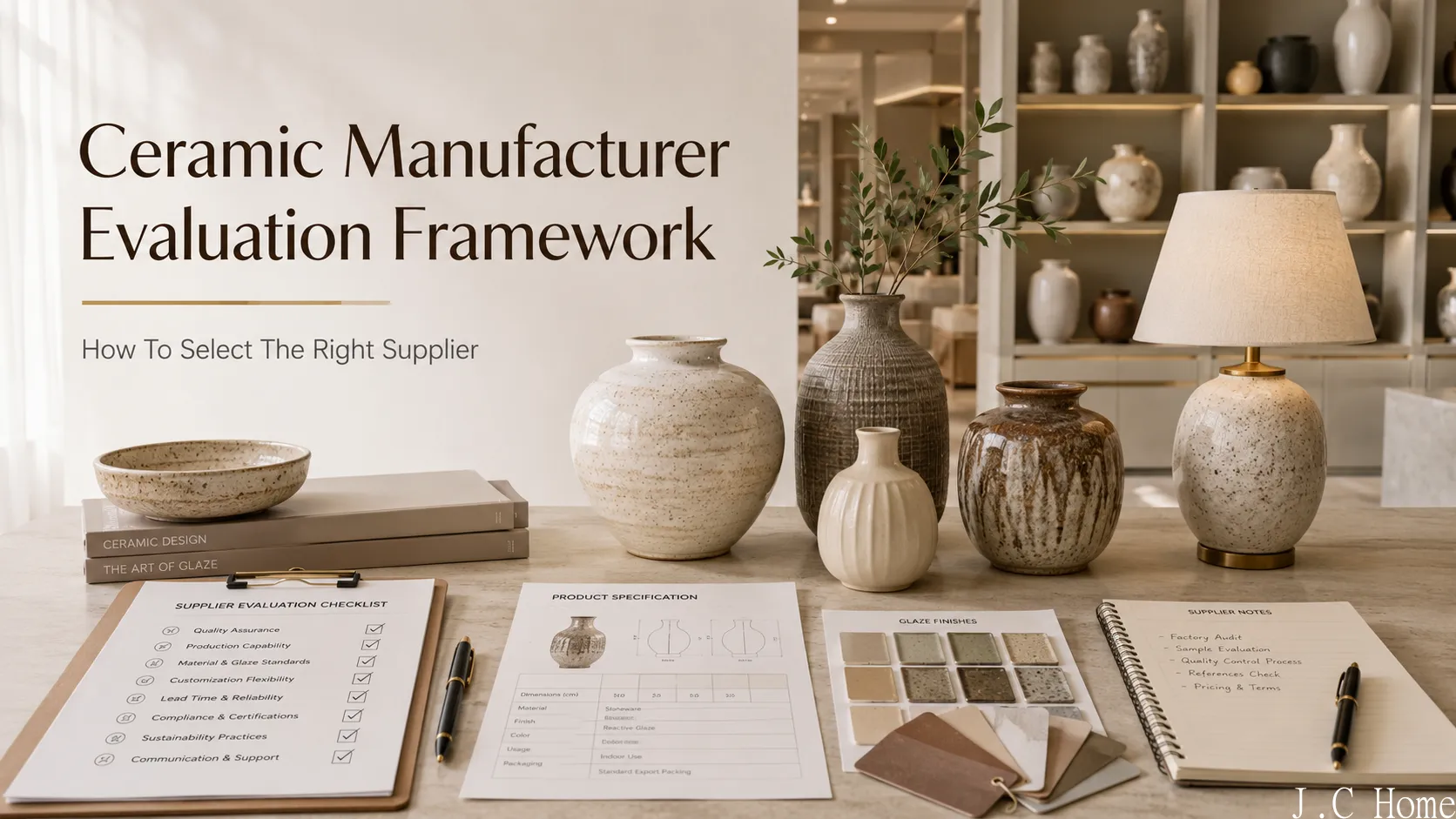
Choosing a ceramic home decor manufacturer is not only about price. Global buyers also need to evaluate product fit, ceramic capability, factory stability, quality control, packaging, compliance awareness, and communication speed. This framework helps brands, importers, retailers, wholesalers, and product development teams compare suppliers before sampling or bulk production.
A strong supplier evaluation process reduces sourcing risk. It also helps buyers avoid inconsistent glaze colors, fragile packaging, unclear inspection standards, and late production updates. For ceramic home decor, these risks matter because appearance, surface finish, batch consistency, and breakage control directly affect retail performance.
If you are sourcing ceramic vases, decorative pots, tabletop accessories, ceramic table lamps, or coordinated home decor collections, use this guide as a practical supplier evaluation checklist.
Why Supplier Evaluation Matters in Ceramic Home Decor Sourcing
Ceramic home decor is highly visual. Buyers are not only buying a shape. They are buying surface quality, color depth, glaze texture, hand-feel, packaging protection, and repeat-order consistency.
A supplier may look attractive in a catalog. However, a catalog cannot show the full production system. It cannot prove batch consistency, sample approval discipline, packaging testing, or defect handling.
That is why supplier evaluation should start before price negotiation.
A practical evaluation process helps buyers answer five questions:
- Can this factory make the product style we need?
- Can it keep color, finish, and size stable across batches?
- Can it support our target market requirements?
- Can it inspect and pack goods before shipment?
- Can it grow with us beyond one order?
For global buyers, these questions matter more than a single low quotation.
A reliable ceramic home decor manufacturer should support long-term product development. It should also help buyers build coherent collections, not just isolated SKUs.
For example, a brand may need ceramic vases, pots, table lamps, and tabletop accessories in matching finishes. In this case, the supplier must understand material consistency, design coordination, packaging, and replenishment planning.
You can explore related ceramic decor categories here: Decor Collection.
You can also review ceramic lighting options here: Table Lamps.
Step 1: Check Product Category Fit
The first evaluation point is simple. Does the supplier actually make your product category?
Many buyers skip this step. They send the same inquiry to many factories. Then they compare prices without checking specialization.
This creates sourcing noise.
A ceramic supplier may be strong in dinnerware but weak in decorative vases. Another factory may make ceramic accessories but not lighting. Some suppliers may only trade products from different workshops.
For home decor brands, category fit should include both current needs and future expansion.
Core Categories to Confirm
| Evaluation Area | What Buyers Should Check | Why It Matters |
|---|---|---|
| Ceramic vases | Shapes, sizes, glaze options, surface finish | Affects retail display and collection planning |
| Decorative pots | Inner finish, drainage needs, surface durability | Impacts plant, gift, and home decor use |
| Tabletop accessories | Shape accuracy, color range, decorative detail | Supports lifestyle and seasonal collections |
| Ceramic table lamps | Ceramic base, lampshade match, electrical parts | Requires both decor and lighting coordination |
| Rechargeable lamps | Battery design, charging details, target market specs | Adds electrical and safety complexity |
| Packaging | Drop protection, retail box needs, label support | Reduces breakage and improves shelf readiness |
A supplier with category fit can understand your design direction faster. It can also suggest realistic production options.
For ceramic products, this includes clay body selection, forming method, glaze effect, firing control, and surface finishing.
For lighting products, the supplier must also coordinate electrical components, shade dimensions, structure, and market-specific specifications.
If your collection includes both decor and lighting, choose a factory that can discuss both sides clearly.
Internal reference: Lighting Collection and Rechargeable Battery Lamps.

Step 2: Evaluate Ceramic Material Capability
Ceramic is flexible, but it is not risk-free. Different ceramic effects require different production control.
A buyer should not only ask, “Can you make this design?”
A better question is, “How will you control this design in production?”
Ceramic home decor depends on many variables. These include clay body, mold quality, drying control, firing temperature, glaze thickness, color reaction, and surface handling.
A capable supplier should explain these factors in practical language. It does not need to overuse technical terms. However, it should understand why ceramic products vary between sample and bulk production.
Ceramic Capability Checklist
| Capability | What to Ask the Supplier | Strong Answer |
|---|---|---|
| Material selection | What ceramic body suits this product? | Supplier explains options based on size, shape, finish, and use |
| Glaze development | Can the glaze be repeated in bulk? | Supplier discusses approved samples and batch control |
| Color control | How do you manage color difference? | Supplier confirms reference samples and tolerance discussion |
| Shape control | How do you control warping or shrinkage? | Supplier explains mold, drying, and firing control |
| Surface finish | Can we choose matte, glossy, textured, or reactive glaze? | Supplier confirms feasibility before sampling |
| Defect handling | What defects are acceptable or unacceptable? | Supplier agrees on inspection criteria before production |
Ceramic buyers should also consider finish positioning. Glossy glaze may look premium in retail lighting. Matte ceramic can work well for modern interior collections. Reactive glaze creates unique visual depth, but it may show more natural variation.
Therefore, buyers should decide which variation is acceptable. A handmade look can be valuable. However, uncontrolled inconsistency can become a quality claim.
For collection-based sourcing, ask the supplier to provide finish boards or color references. These help your team align design, buying, and retail presentation before bulk orders.
Fact Check — True
A ceramic product can pass visual approval as a sample but still fail repeat-order expectations.
Buyers should evaluate whether the supplier can reproduce glaze, shape, and packaging quality across multiple batches. This matters for retail continuity and long-term replenishment.
Step 3: Review Factory Audit Readiness
A factory audit does not need to be complicated for every order. However, buyers should still evaluate whether the supplier can show basic production control.
A factory audit helps buyers understand the real operating system behind the quotation.
For ceramic home decor, the audit should focus on production flow, sample control, quality checkpoints, packing process, material storage, and corrective actions.
You do not need to audit every detail on the first contact. However, you should confirm whether the supplier can answer audit-related questions.
Key Factory Audit Areas
1. Production Process
Ask the supplier to explain the main production process.
For ceramic decor, this may include forming, drying, trimming, bisque firing, glazing, final firing, finishing, inspection, and packing.
For ceramic lamps, the process may also include drilling, fitting, wiring, lampshade matching, electrical assembly, and final function checks.
The supplier should understand where quality risks appear.
2. Sample Approval
Sample approval must be controlled. A sample is not only a beautiful piece for photography. It is the production reference.
Ask whether the supplier keeps approved samples. Also ask whether production teams use them during bulk manufacturing.
A strong supplier should compare bulk goods against approved samples before shipment.
3. Material and Component Control
Ceramic products may use glazes, metal parts, wood parts, lampshades, cords, batteries, chargers, labels, and cartons.
Buyers should ask how these materials are sourced and checked.
For lighting and rechargeable products, component control is especially important. Electrical parts should match the destination market requirements.
4. Production Capacity and Scheduling
A supplier may accept an order but fail to manage timing. Therefore, buyers should ask about production schedule planning.
You do not need to ask for confidential factory data. Instead, ask how the supplier confirms lead time, handles peak season, and communicates delays.
5. Corrective Action
Defects can happen in ceramic production. The important question is how the supplier responds.
Ask whether the supplier records defects, analyzes causes, and updates production controls.
A factory that cannot explain corrective action may repeat the same issue in future orders.
Step 4: Assess the Quality Inspection System
A quality inspection system should be practical. It should match the product type, order size, and target market.
For ceramic home decor, inspection should not focus only on quantity. It should also cover visual quality, surface finish, color consistency, product stability, packaging, labels, and carton condition.
For ceramic lamps, inspection should also include assembly, function, structure, shade alignment, and electrical details.
Recommended Inspection Points
| Inspection Stage | What to Check | Buyer Benefit |
|---|---|---|
| Incoming material check | Ceramic body, glaze materials, components, packaging materials | Reduces hidden production risk |
| In-process inspection | Shape, drying cracks, glaze coverage, firing result | Finds problems before final packing |
| Pre-pack inspection | Color, surface, dimensions, stability, accessories | Confirms product appearance before carton sealing |
| Function check | Lamp switch, charging, cable, fittings, shade alignment | Important for lighting and rechargeable products |
| Packing inspection | Inner protection, labels, carton marks, barcode needs | Reduces breakage and receiving problems |
| Final random inspection | AQL sampling, defect classification, order conformity | Supports shipment decision |
Buyers should define defect categories before inspection.
Critical defects affect safety or usability. Major defects affect function, appearance, or saleability. Minor defects may affect presentation but not core use.
Ceramic products often require visual tolerance discussion. For example, tiny glaze specks may be acceptable for some rustic finishes. However, they may be unacceptable for clean modern retail collections.
This is why inspection standards should match the product design.
If buyers use third-party inspection, they should share the same criteria with the supplier before production. This avoids disputes after goods are finished.
International sampling standards can help buyers structure lot-by-lot inspections. However, buyers should confirm the latest sampling plan with their inspection partner.
Fact Check — False
“A low defect rate in one sample means the supplier has stable bulk quality.”
A sample only proves sample capability. Bulk production needs process control, approved references, in-process checks, final inspection, and packaging verification.

Step 5: Evaluate Compliance Awareness for EU and US Markets
Global buyers should not expect one universal compliance answer for every ceramic product. Requirements depend on product type, market, function, material, and sales channel.
A decorative ceramic vase has different concerns from a ceramic table lamp. A food-contact tabletop item has different concerns from a purely decorative object.
Therefore, compliance evaluation should start with product use.
Questions Buyers Should Ask
- Is this product decorative only?
- Will it contact food?
- Does it include electrical parts?
- Does it include batteries?
- Will it be sold in the EU, US, UK, or another market?
- Does the retailer require specific packaging or labeling?
- Does the product need testing before shipment?
For EU consumer products, buyers should review general product safety obligations. For US sales, buyers should confirm applicable CPSC rules and other product-specific requirements.
For luminaires, buyers should confirm applicable lighting safety standards for the destination market.
For ceramic items intended to contact food, buyers should confirm food-contact regulations. This is especially important for products such as bowls, plates, mugs, and certain tabletop accessories.
Decorative vases and accessories may not be food-contact products. However, buyers should still confirm intended use and labeling.
A strong ceramic home decor manufacturer should not make vague compliance promises. Instead, it should help buyers clarify the product category and target market before sampling.
It should also support documentation when applicable. This may include material information, product specifications, test reports, packaging details, and production references.
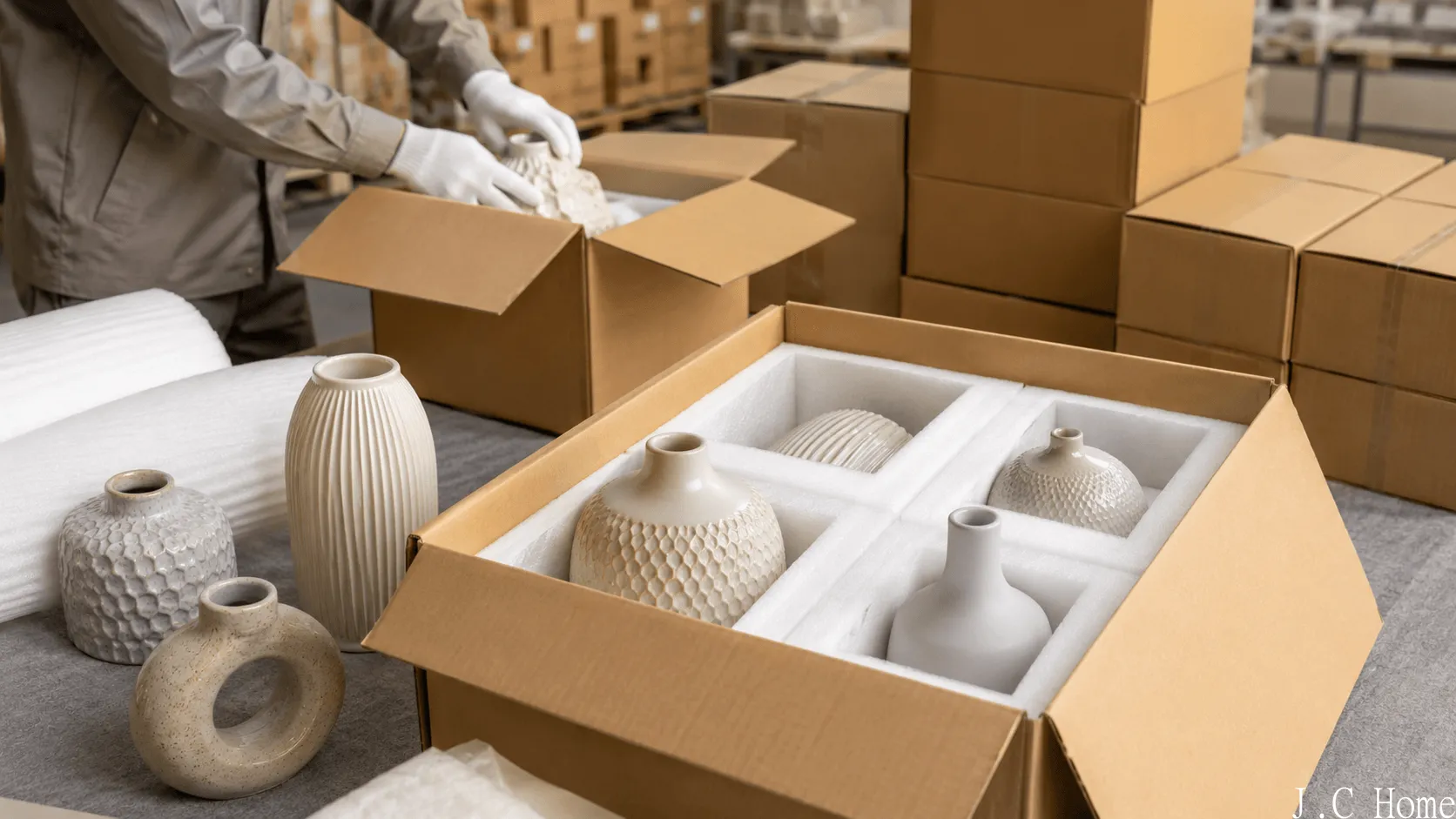
Step 6: Check Packaging and Breakage Control
Packaging is a major sourcing criterion for ceramic home decor.
Ceramic products can look perfect in the showroom but fail during transport. Breakage claims can damage margins, retailer trust, and launch schedules.
A good packaging system should protect the product and support the sales channel.
For wholesale buyers, packaging may focus on safe carton loading and warehouse handling. For retailers, packaging may also need barcodes, labels, inner boxes, retail boxes, and shelf-ready presentation.
For e-commerce sellers, packaging may need stronger drop protection.
Packaging Evaluation Checklist
| Packaging Area | What to Confirm | Why It Matters |
|---|---|---|
| Inner protection | Foam, molded pulp, paper buffer, corner protection | Reduces breakage during transit |
| Carton strength | Export carton quality and sealing method | Protects goods during stacking |
| Product separation | Avoids ceramic-to-ceramic contact | Prevents chips and scratches |
| Labeling | SKU, barcode, carton mark, destination details | Supports warehouse receiving |
| Retail packaging | Gift box, color box, product insert | Improves retail presentation |
| Drop test needs | Confirm with buyer or retailer requirements | Supports safer transport planning |
Buyers should share their sales channel early. A product shipped to a wholesale warehouse may need different packaging from a product shipped directly to consumers.
Moreover, packaging should be approved before mass production. Do not wait until final inspection to discuss carton structure.
A supplier with packaging experience can reduce hidden costs. It can also protect the product image when goods arrive.
Step 7: Compare Communication and Development Support
Supplier evaluation should include communication quality.
A supplier may have good production capability. However, poor communication can still create sourcing risk.
Global buyers need clear updates, practical questions, and fast issue escalation.
For custom ceramic home decor projects, communication matters from the first inquiry. The supplier should ask about size, finish, target market, packaging, order plan, and usage scenario.
A supplier that only says “yes” may not be the best choice. A supplier that asks precise questions often understands production risk better.
Communication Signals to Watch
Good signals:
- The supplier asks about target market.
- The supplier explains feasible ceramic finishes.
- The supplier confirms product use before quoting.
- The supplier discusses packaging early.
- The supplier separates sample approval from bulk production.
- The supplier provides clear next steps.
Risk signals:
- The supplier gives a price without product details.
- The supplier promises all finishes without testing.
- The supplier avoids quality questions.
- The supplier cannot explain packaging.
- The supplier refuses to discuss inspection criteria.
- The supplier only competes on low price.
For long-term cooperation, choose a supplier that communicates like a product development partner.
You can share your collection direction through the Contact Us page. Include product type, market, style reference, quantity plan, packaging needs, and timeline.
Step 8: Build a Practical Supplier Scoring Framework
A scoring framework helps buyers compare suppliers objectively.
It also prevents over-focusing on price.
You can adjust the score based on your business model. A retailer may prioritize packaging and repeat-order stability. A design brand may prioritize finish development. An importer may prioritize inspection and shipment consistency.
Ceramic Supplier Evaluation Scorecard
| Evaluation Area | Weight | What to Review |
|---|---|---|
| Product category fit | High | Does the supplier make your core product type? |
| Ceramic material capability | High | Can it control glaze, shape, color, and finish? |
| Quality inspection system | High | Does it inspect during production and before shipment? |
| Factory audit readiness | Medium | Can it explain process, sample control, and corrective action? |
| Packaging capability | High | Can it protect fragile ceramic products for your channel? |
| Compliance awareness | High | Does it understand EU, US, food-contact, or lighting concerns? |
| Custom development support | Medium | Can it support size, color, finish, label, and packaging requests? |
| Communication quality | High | Does it ask useful questions and respond clearly? |
| Long-term supply fit | High | Can it support repeat orders and collection planning? |
Use the scorecard before placing sample orders. Then update the score after sampling, inspection, and first shipment.
A supplier can improve over time. However, early evaluation helps you avoid major sourcing mistakes.
For broader sourcing planning, you may also read: Home Decor Manufacturer China: OEM Guide and Custom Ceramic Decor Manufacturer Wholesale Guide.
Common Mistakes Buyers Make When Evaluating Ceramic Suppliers
Mistake 1: Comparing Only Unit Price
Low price may look attractive. However, it can hide weak packaging, poor glaze control, limited inspection, or unclear communication.
A better comparison includes total sourcing risk.
Mistake 2: Approving a Sample Without Defect Criteria
A sample should define expectations. Buyers should confirm acceptable and unacceptable defects before bulk production.
Mistake 3: Ignoring Packaging Until the End
Packaging affects cost, breakage, and retailer satisfaction. Discuss it early.
Mistake 4: Treating Decorative and Functional Products the Same
A ceramic lamp is not just a ceramic object. It also includes lighting structure and electrical concerns.
Mistake 5: Assuming Compliance Is Automatic
Compliance depends on market and product use. Buyers should confirm requirements before production.
Mistake 6: Not Planning Repeat Orders
Many ceramic products are sold as collections. Repeat-order consistency matters for brands and retailers.
How to Prepare an Inquiry for a Ceramic Home Decor Manufacturer
A clear inquiry helps the supplier respond accurately.
Instead of sending only a picture, include practical buying information.
Inquiry Information to Include
- Product category
- Target market
- Intended use
- Size range
- Material preference
- Finish or glaze reference
- Color direction
- Packaging requirement
- Label or barcode needs
- Estimated order plan
- Sample request
- Inspection requirement
- Timeline
- Any retailer compliance requirements
This information helps the supplier check feasibility before quoting.
It also reduces unnecessary back-and-forth communication.
If you need ceramic vases, pots, tabletop accessories, or ceramic lighting collections, you can start from the Decor Collection or send project details through Contact Us.
FAQ
1. What should global buyers look for in a ceramic home decor manufacturer?
Buyers should check product category fit, ceramic capability, quality inspection, packaging, compliance awareness, communication, and long-term supply stability. Price matters, but it should not be the only sourcing criterion.
2. How do I evaluate ceramic product quality before bulk orders?
Start with samples. Then define acceptable defects, color tolerance, size tolerance, surface finish expectations, packaging needs, and inspection criteria before production.
3. What is a factory audit for ceramic suppliers?
A factory audit reviews the supplier’s production process, sample control, material management, quality checkpoints, packing process, and corrective action system. It helps buyers understand the supplier behind the quotation.
4. Why is glaze consistency important for ceramic home decor?
Glaze affects color, texture, and retail appearance. Inconsistent glaze can make products look mismatched, especially in coordinated collections.
5. Should buyers use AQL inspection for ceramic products?
Many buyers use AQL-based sampling for final random inspection. However, buyers should confirm the latest sampling plan, defect levels, and inspection scope with their inspection partner.
6. What compliance questions should I ask a ceramic supplier?
Ask about target market, product use, food-contact status, electrical parts, batteries, labeling, packaging, and available documentation. Requirements vary by product and market.
7. Is a ceramic vase considered a food-contact product?
Usually, a decorative vase is not a food-contact product. However, buyers should confirm intended use and labeling. If a ceramic item touches food, food-contact rules may apply.
8. What makes ceramic lamp sourcing more complex?
Ceramic lamps combine ceramic appearance with lighting structure. Buyers should evaluate ceramic body quality, shade fit, wiring, components, function checks, and destination-market requirements.
9. How can buyers reduce breakage in ceramic shipments?
Discuss packaging early. Confirm inner protection, carton strength, product separation, labels, and any drop test requirements from your retailer or sales channel.
10. When should I contact a supplier?
Contact a supplier after you define product category, style direction, target market, packaging needs, and estimated order plan. This helps the supplier provide a realistic response.
Conclusion
A ceramic home decor manufacturer should be evaluated as a long-term sourcing partner, not only as a price provider.
Global buyers should review category fit, ceramic capability, factory audit readiness, quality inspection, packaging, compliance awareness, and communication quality. These factors help protect retail presentation, shipment reliability, and repeat-order consistency.
For ceramic home decor, visual quality and production control are closely connected. A strong sample is useful, but a stable production system is more important.
If you are developing ceramic vases, decorative pots, tabletop accessories, ceramic table lamps, or coordinated home decor collections, start with a structured supplier evaluation process.
Explore J.C Home Decor product categories here: Decor and Lighting.
To discuss a sourcing project, custom finish, packaging plan, or inspection requirement, contact J.C Home Decor here: Contact Us.
References
-
ISO 9001:2015 — Quality management systems requirements — Supports quality management and supplier control concepts.
↩ -
ISO 2859-1:2026 — Sampling procedures for inspection by attributes — Supports AQL-based inspection planning for lot-by-lot inspection.
↩ -
European Commission Access2Markets — EU General Product Safety Regulation — Supports EU product safety awareness for consumer goods.
↩ -
U.S. Consumer Product Safety Commission — Business Education — Supports product safety compliance awareness for U.S. consumer products.
↩ -
IEC 60598-1:2024 — Luminaires general requirements and tests — Supports lighting safety awareness for ceramic lamps and luminaires.
↩ -
European Commission — Food Contact Materials Legislation — Supports food-contact awareness for ceramic articles intended to contact food.
↩
Buyer Checklist Before Requesting a Quote
| Information to Prepare | Why It Helps |
|---|---|
| Product category and target use | Helps confirm the right lighting or decor direction. |
| Target market | Supports electrical, packaging, labeling, and document discussion. |
| Material, color, and finish direction | Reduces misunderstanding during sample communication. |
| Packaging and label needs | Important for fragile products and retail-ready planning. |
| Reference images or collection mood | Helps align design language before quotation. |
Clear buyer information helps reduce misunderstanding before sample and order communication.