J.C Home Decor and Lighting Manufactory



Wholesale table lamps are not only products to buy in bulk. For retailers, importers, home decor brands, and design partners, they should work as a clear product collection. A strong assortment helps buyers create better displays, manage packaging, prepare private label details, and support repeat orders. Therefore, this guide explains how to plan table lamp assortments, compare wholesale and custom options, prepare packaging requirements, and avoid common bulk order mistakes before requesting a quote.

Why Wholesale Table Lamps Should Be Planned as a Collection
Many buyers start by selecting individual lamps they like. However, this approach can create a scattered product line. A retail store may end up with too many unrelated shapes, colors, and shade styles.
Instead, wholesale table lamps should be planned as a connected collection. A collection gives buyers more control over visual direction, price range, display planning, and repeat orders. It also helps suppliers understand the buyer’s market position.
For example, a home decor retailer may need a soft neutral ceramic table lamp group for bedside tables and console displays. Meanwhile, an importer may need a broader range that includes affordable wholesale table lamps, modern table lamps wholesale, and decorative table lamps wholesale for different retail channels.

Single Product Buying vs Collection-Based Buying
Single product buying focuses on one lamp at a time. It may work for trial orders or limited project needs. However, it often fails to support consistent retail merchandising.
Collection-based buying is different. It looks at the full product group. Buyers consider materials, colors, sizes, lamp shades, packaging, and future repeat orders before confirming a bulk table lamps supply plan.
Why Retail Buyers Need Style Families
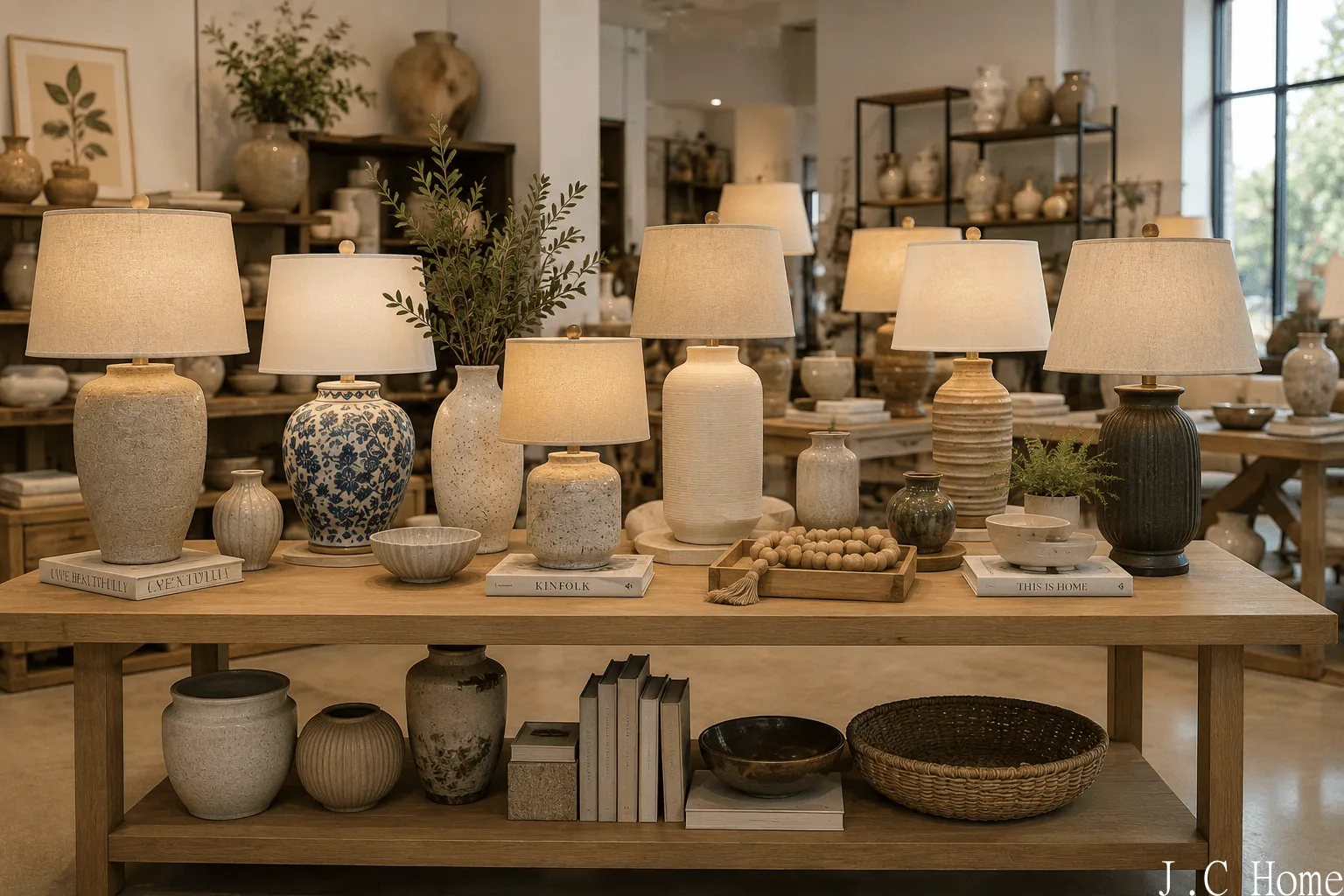
Retail buyers need table lamps that look related. Therefore, a style family is useful. A style family may include several lamps with similar finishes, matching shade colors, and different sizes.
For this reason, buyers should not only ask, “Is this lamp attractive?” They should also ask, “Can this lamp sit naturally beside other products in our store?”
Who Needs Collection-Based Wholesale Table Lamps?
Wholesale table lamps can serve several buyer types. However, each buyer has a different purchasing logic.
Home decor retailers usually care about display value and resale potential. Importers often care about carton planning, labeling, repeat supply, and target market requirements. Private label brands need stronger control over packaging, color direction, and collection identity.
Interior designers and design studios may use bulk table lamps for residential projects, model rooms, villas, or commercial interiors. In addition, selected hospitality buyers may need hotel table lamps wholesale for guest rooms, lounges, or restaurant spaces.
Main Buyer Types
| Buyer Type | Main Need | What to Confirm |
|---|---|---|
| Home decor retailer | Sellable table lamp assortment | Style family, display size, shade color, packaging |
| Importer | Stable bulk table lamps supply | Carton, label, target market, repeat order plan |
| Private label brand | Brand-ready product line | Logo, packaging, finish direction, SKU logic |
| Interior designer | Space coordination | Size, proportion, material, shade style |
| Hospitality buyer | Application consistency | Durability, replacement plan, electrical details |
For JC Home Decor, the main content direction should support long-term partners, retail partners, importers, designers, and selected project buyers. Hotels and commercial interiors can appear as application scenarios. However, they should not dominate the article.
How to Build a Table Lamp Assortment for Retail
A strong table lamp assortment starts with a clear design direction. Before ordering, buyers should decide whether the collection should feel modern, classic, rustic, natural, luxury, coastal, or transitional.
After that, buyers can choose materials, finishes, shade colors, and sizes. This process helps the final product group look intentional. In addition, it reduces confusion during quotation and sampling.
Start with a Core Style Direction
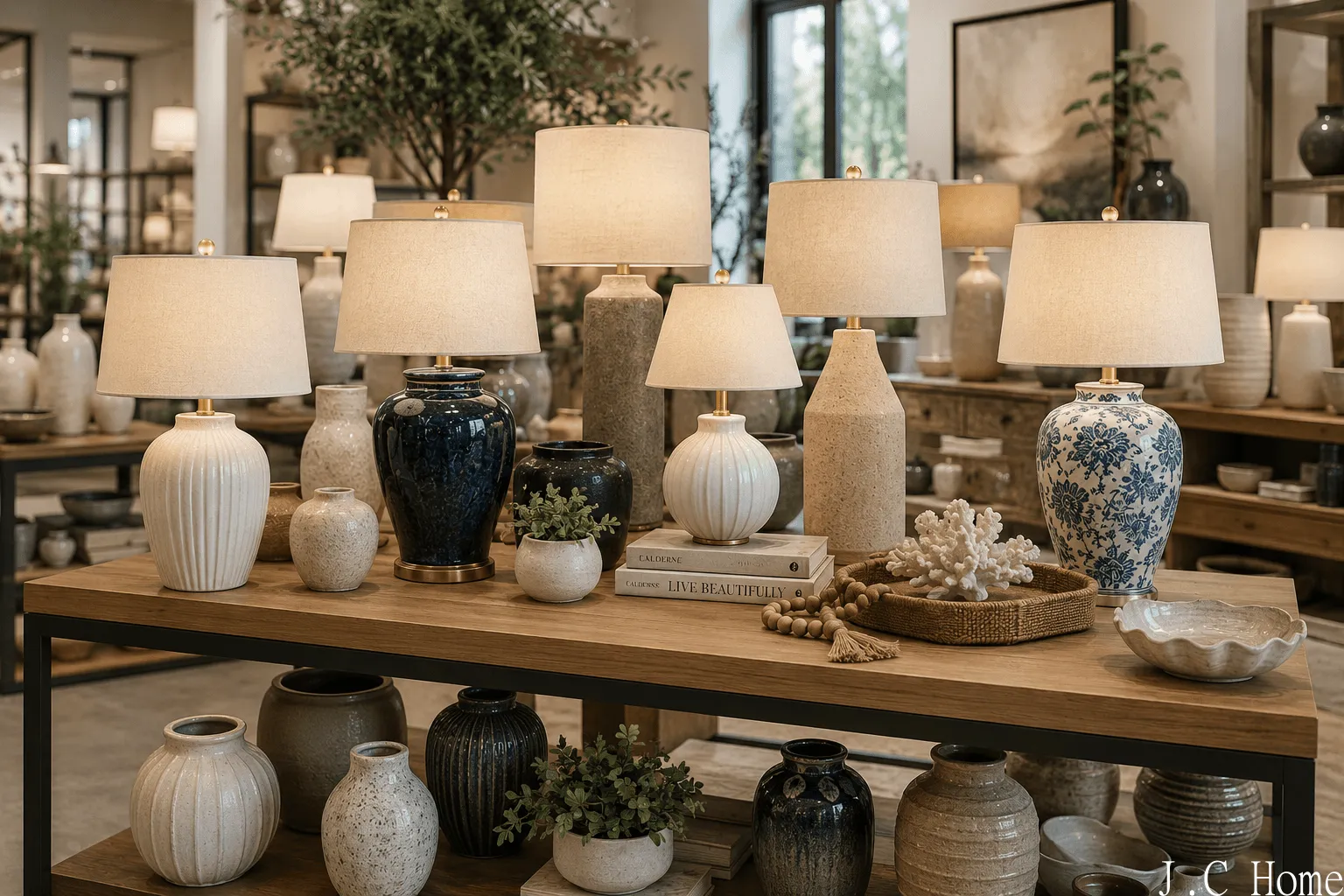
A table lamp collection should begin with one core style direction. For example, a modern collection may use simple ceramic bases, clean drum shades, and neutral finishes. A luxury table lamp wholesale collection may use richer materials, glossy finishes, metallic details, or sculptural shapes.
However, buyers should avoid mixing too many unrelated styles in one order. If one collection includes farmhouse, industrial, luxury, coastal, and minimalist lamps together, the final display may look unclear.
Choose 2–3 Material Families
Material choice affects appearance, weight, packaging, and perceived value. Therefore, buyers should choose materials based on their retail positioning.
Ceramic and porcelain table lamps work well for decorative home decor collections. Metal table lamps may suit modern or structured interiors. Glass and crystal table lamps can support refined retail displays. In addition, natural or mixed materials may fit lifestyle stores and relaxed interior styles.
Plan Size Ranges for Different Displays
A retail assortment should include different size ranges. Small table lamps can work for shelves and bedside displays. Medium lamps can support living room side tables. Larger statement lamps can work on consoles, entry tables, or showroom displays.
In practice, buyers should confirm lamp height, base width, shade diameter, and overall proportion before sampling. These details affect both visual value and packaging.
Coordinate Shade Shapes and Colors
Lamp shades strongly affect the final look. A good table lamp body can look weak if the shade is too small, too dark, or out of proportion.
For retail collections, buyers should coordinate shade colors across the assortment. Neutral fabric shades are often easier to combine with different lamp bases. However, custom shade colors may help private label brands build a stronger collection identity.
Collection Planning Matrix
The following matrix helps buyers organize wholesale table lamps before requesting a quotation.
| Planning Area | Buyer Question | Why It Matters |
|---|---|---|
| Style family | Do the lamps belong to one clear design direction? | Helps retailers create a coherent display |
| Material mix | Should the collection use ceramic, metal, glass, or mixed materials? | Affects price, weight, packaging, and visual value |
| Size range | Are there small, medium, and statement sizes? | Supports shelves, consoles, bedside tables, and showrooms |
| Shade design | Do the shades match the lamp bodies? | Affects proportion and perceived value |
| Packaging | Is the packaging suitable for bulk shipping or resale? | Reduces damage risk and supports retail presentation |
| Repeat order | Can the style be repeated or extended? | Supports long-term product planning |
Assortment Planning by Retail Position
Not every buyer needs the same table lamp collection. Therefore, the assortment should match the buyer’s channel and price position.
Affordable wholesale table lamps may focus on simple shapes, practical sizes, and efficient packaging. Modern table lamps wholesale may focus on clean forms, neutral colors, and material texture. Luxury table lamp wholesale may require more attention to finish, proportion, shade quality, and presentation.
Affordable Wholesale Table Lamps
Affordable wholesale table lamps should still look considered. Buyers should not only focus on low cost. Instead, they should confirm whether the lamp has a clear style, safe packaging, and suitable size for resale.
In addition, affordable collections should avoid overly complex structures. Simple forms often support easier production, cleaner packaging, and more stable repeat orders.
Modern Table Lamps Wholesale
Modern table lamps wholesale should feel clean, balanced, and easy to place in different interiors. Neutral ceramic bases, matte finishes, soft curves, and simple fabric shades can work well for many home decor stores.
However, modern does not mean plain. Texture, proportion, and finish can make a simple lamp look more valuable.
Luxury Table Lamp Wholesale
Luxury table lamp wholesale often depends on details. Buyers may look at glossy finishes, sculptural bases, metallic accents, glass, crystal, porcelain, or refined shade materials.
Because luxury lamps may have higher perceived value, packaging should also match the product position. For higher-end retail programs, buyers may discuss stronger presentation packaging, inserts, or custom packaging plans early.
Packaging Planning for Bulk Table Lamps Supply
Packaging is one of the most important parts of bulk table lamps supply. Table lamps may include fragile bases, shades, sockets, cords, accessories, and surface finishes. Therefore, packaging should be discussed before sample approval, not after production.
For example, a ceramic table lamp may need inner support around the base. A fabric shade may need enough space to avoid deformation. A glass or porcelain lamp may require stronger protection during export shipping.
Retail Box vs Export Carton vs Project Packaging
Different buyer scenarios need different packaging plans.
A home decor retailer may care about retail presentation. An importer may care more about export cartons, shipping marks, labels, and warehouse handling. A private label brand may need custom packaging table lamp wholesale support, including logo, color box, label, or product information.
Meanwhile, a hotel or commercial project buyer may not need retail packaging. Instead, the buyer may care about clear room allocation, replacement parts, and protected bulk delivery.
Packaging Options for Wholesale Table Lamps
| Packaging Type | Suitable Use | Buyer Should Confirm |
|---|---|---|
| Export carton | Bulk shipping | Inner support, carton strength, lamp protection |
| Retail box | Store or online resale | Product information, box structure, presentation |
| Gift box | Higher-end retail collection | Material, insert, cost impact, brand fit |
| Neutral carton | Importer or distributor use | Label, SKU, shipping marks |
| Custom packaging | Private label orders | Logo, color, inserts, market requirements |
Why Packaging Should Be Discussed Early
Packaging affects more than shipping. It can affect cost, carton size, warehouse handling, retail presentation, and product damage risk.
For this reason, buyers should share packaging expectations before quotation. If the packaging requirement changes after sampling, the supplier may need to adjust carton structure, inserts, materials, or cost.
Fact Check: Packaging Can Wait Until After Production
False. Packaging should not wait until the bulk order is finished. For wholesale table lamps, packaging should be discussed before sample approval or bulk order confirmation.
This is especially important for ceramic, porcelain, glass, large lamp bodies, lampshades, and private label retail boxes. In addition, European buyers may have packaging-related expectations, so packaging should be reviewed early when the target market is Europe.
Private Label Table Lamp Wholesale: What Buyers Should Prepare
Private label table lamp wholesale can help retailers and home decor brands build a stronger product identity. However, buyers should prepare clear requirements before asking for quotation.
Private label does not always mean developing a completely new lamp. In many cases, buyers start with an existing form and adjust the finish, shade, label, carton, or packaging direction. This approach can be practical for retail collection development.
Logo and Label Needs
Buyers should prepare logo files, label requirements, and placement instructions. They should also explain whether the logo appears on the lamp, carton, product label, hangtag, instruction sheet, or retail box.
However, label requirements may depend on target market and product type. Therefore, buyers should avoid assuming one label format works for every market.
Color Box or Neutral Carton Direction
Private label buyers should confirm whether they need a retail color box, neutral carton, or custom export carton. A retail color box may support store presentation. Meanwhile, a neutral carton may be better for importers who distribute to different channels.
Product Line Naming and SKU Logic
A private label collection should have clear SKU logic. For example, buyers can group lamps by material, color, size, or shade type.
This helps retailers manage inventory. It also helps importers plan repeat orders and future collection expansion.
Repeat Order Planning for Wholesale Table Lamps
Repeat order planning is often ignored during the first quotation. However, it is important for long-term retail programs and importer relationships.
A buyer may love the first order, but problems can appear later if color, shade, finish, packaging, or labeling changes without control. Therefore, buyers should plan repeat order requirements from the beginning.
Why Repeatability Matters
Repeatability helps buyers maintain collection consistency. It also helps retail teams reorder successful styles without rebuilding the whole assortment.
For example, if a ceramic table lamp becomes a strong seller, the buyer may want to repeat the same finish or extend the style into new colors. If the original requirements were unclear, repeat ordering may become difficult.
Color and Finish Consistency
Colors and finishes should be reviewed carefully. Ceramic glazes, hand-applied finishes, metallic coatings, and textured surfaces may have natural variation. Therefore, buyers should confirm acceptable variation during sample review.
This does not mean every product must be visually identical. Instead, it means buyers and suppliers should agree on what level of variation is acceptable for the target market.
Shade Replacement and Matching
Lamp shades should also be part of repeat order planning. Buyers should confirm shade shape, diameter, color, fabric texture, and fitting method.
In addition, buyers should discuss whether replacement shades or matching shades may be needed for future orders.
Packaging Version Control
Packaging may change between orders if it is not controlled. For private label orders, buyers should keep approved artwork, carton information, label placement, and packaging structure organized.
As a result, future orders can be repeated more smoothly.
Fact Check: Custom Table Lamp Wholesale Always Means a New Design
False. Custom table lamp wholesale does not always require a completely new design.
In practice, customization may include finish, body color, shade color, lampshade material, label, logo, packaging, or product grouping. A full new mold or new lamp body may only be needed when the buyer wants a unique shape or special design direction.
Therefore, buyers should explain their goal first. The supplier can then discuss whether standard wholesale, light customization, private label packaging, or deeper product development is more suitable.
Standard Wholesale vs Custom Table Lamp Wholesale
Both standard wholesale and custom table lamp wholesale can be useful. The right option depends on the buyer’s timeline, brand needs, market position, and order plan.
| Option | Best For | Buyer Should Prepare |
|---|---|---|
| Standard wholesale | Faster assortment building | Style range, quantity direction, target market |
| Custom table lamp wholesale | Collection development | Reference images, material, finish, shade needs |
| Private label wholesale | Brand resale | Logo, labels, packaging brief |
| Imported table lamps wholesale | Distribution and retail channels | Market, carton, labeling, documentation needs |
| Project bulk order | Residential, hotel, or commercial interiors | Room type, quantity, size, electrical details |
When Standard Wholesale Works Better
Standard wholesale may work better when buyers need to test a market, build an entry-level range, or add products quickly to an existing catalog.
However, buyers should still confirm size, finish, shade, packaging, and target market needs. Even standard wholesale table lamps require careful review before a commercial table lamp bulk order.
When Custom Table Lamp Wholesale Works Better
Custom table lamp wholesale may work better when a buyer needs a coordinated retail collection, a private label program, a specific finish, or custom packaging.
For example, a home decor brand may want three ceramic table lamps in related shapes with one shade family and consistent packaging. In this case, custom discussion can create a stronger product story.
Bulk Table Lamps for Retailers, Importers, and Designers
Wholesale table lamps can support several channels. However, each channel should use a different planning logic.
Bulk Table Lamps for Retailers
Retailers should focus on display value, product range, packaging, and resale positioning. They should also choose lamps that work with other home decor items, such as vases, pots, table top accessories, mirrors, and small furniture.
For retail buyers, table lamps should help create a complete home decor story. Therefore, the lamp collection should not look isolated from the rest of the store.
Residential Table Lamp Bulk Supply
Residential table lamp bulk supply may serve show homes, apartment projects, furniture packages, or home decor stores. Buyers should check size, room placement, material, shade color, and overall style.
In addition, residential projects may require repeated styles across bedrooms, living rooms, and entry areas.
Table Lamp Bulk for Interior Designers
Interior designers often care about proportion and material harmony. A lamp may look good alone, but it must also work with furniture, wall color, fabric, flooring, and decorative accessories.
Therefore, designers should provide room style, approximate placement, quantity, and finish preferences before requesting a quote.
Hotel Table Lamps Wholesale as an Application Scenario
Hotel table lamps wholesale orders may focus on room consistency, replacement planning, durability, electrical details, and packaging for project delivery.
However, this article does not treat hospitality as the only buyer type. Hotel, restaurant, and commercial interiors are application scenarios within a broader wholesale table lamp supply strategy.
Quality and Compliance Questions Before Large Quantity Table Lamp Orders
Before placing large quantity table lamp orders, buyers should confirm quality and compliance details with the supplier. This is especially important for electrical lighting products, target market requirements, packaging, labels, and buyer channel standards.
For this reason, buyers should not assume that one requirement fits every lamp or every market. Instead, they should confirm product details, destination market, electrical configuration, and required documents before order confirmation.
Electrical Details Depend on Target Market
Electrical requirements may depend on plug type, voltage, lamp holder, switch, cord, bulb type, rechargeable battery system, and target market.
Therefore, buyers should share the destination market before quotation. This helps the supplier discuss suitable details and required documents.
Packaging and Labeling Should Be Confirmed Early
Packaging and labels may affect retail use, warehouse handling, customs documents, and target market requirements. In Europe, decorative lighting buyers may also ask suppliers to follow specific packaging and labeling instructions.
For this reason, buyers should prepare packaging and label needs early.
Samples Should Be Reviewed Before Bulk Orders
Samples are important for checking proportion, finish, shade, packaging, and product details. They also help buyers confirm whether the lamp fits the intended retail collection.
Before bulk order confirmation, buyers should review the sample together with packaging requirements and target market information.
Fact Check: All Markets Use the Same Table Lamp Requirements
False. Requirements can vary by product type, target market, electrical configuration, plug, light source, packaging, label, and buyer channel.
Therefore, buyers should confirm compliance documents before ordering. They should not rely on general claims without checking the specific lamp and target market.
RFQ Checklist for Custom Table Lamp Wholesale
A clear RFQ helps both the buyer and supplier. It reduces back-and-forth communication and makes the quotation more practical.
Before contacting a table lamp manufacturer wholesale supplier, buyers should prepare the following details.
| RFQ Item | What to Prepare | Why It Matters |
|---|---|---|
| Product category | Table lamps, decorative table lamps, rechargeable lamps, or mixed lighting | Clarifies product scope |
| Quantity direction | Trial order, repeat order, or large quantity table lamp orders | Supports quotation discussion |
| Style references | Images, mood boards, or similar products | Reduces misunderstanding |
| Material request | Ceramic, porcelain, metal, glass, resin, rattan, or mixed materials | Affects cost, weight, and finish |
| Finish direction | Matte, glossy, textured, metallic, hand-painted, or neutral | Helps collection planning |
| Shade requirements | Shape, size, color, material, fitting | Affects proportion and final look |
| Packaging needs | Export carton, retail box, gift box, or custom packaging | Affects protection and presentation |
| Private label needs | Logo, label, carton artwork, product information | Supports brand resale |
| Target market | Europe, United States, or other market | Affects electrical and label review |
How Buyers Can Use This Checklist
Buyers can use this checklist before contacting JC Home Decor. For example, they can first review the Table Lamps category, choose suitable style references, and then prepare material, shade, quantity, and packaging information.
After that, they can send a focused request through the Contact Us or Get a Quote page. This process helps the discussion start from real buyer requirements instead of general product questions.
Common Mistakes to Avoid
Wholesale table lamp sourcing becomes easier when buyers avoid several common mistakes.
Choosing Lamps Only by Photos
Photos help buyers understand style. However, photos do not show all important details. Buyers should also confirm size, weight, shade proportion, finish, packaging, and target market requirements.
Mixing Too Many Styles in One Order
A collection with too many unrelated styles may be difficult to display and reorder. Instead, buyers should build a clear assortment around materials, colors, and sizes.
Discussing Packaging Too Late
Packaging should be part of early sourcing communication. Otherwise, the final carton, insert, retail box, or private label packaging may not match the buyer’s resale needs.
Ignoring Repeat Order Consistency
Repeat order planning should start before the first order. Buyers should record approved samples, colors, shades, packaging versions, and label details.
Treating Retail and Project Orders the Same
Retail orders and project orders have different priorities. Retailers focus on resale, display, packaging, and collection planning. Project buyers may focus more on room placement, replacement needs, and delivery grouping.
Asking for Certification Claims Without Product Details
Compliance documents depend on product type and target market. Therefore, buyers should share electrical requirements and destination market first. They should also avoid relying on broad claims that are not tied to a specific product.
FAQ
1. How should retailers plan wholesale table lamps as a collection?
Retailers should start with one clear style direction. Then, they should choose related materials, finishes, sizes, and shade colors. This helps the collection look coherent in store displays and online product pages.
2. How many table lamp styles should a retail buyer start with?
A buyer can start with a focused group instead of too many unrelated designs. For example, a small collection may include several related shapes, two or three size levels, and one consistent shade direction. The exact number depends on the buyer’s market, budget, and display plan.
3. What is the difference between standard wholesale and custom table lamp wholesale?
Standard wholesale uses existing product options. Custom table lamp wholesale may adjust color, finish, shade, label, packaging, or product grouping. In some cases, deeper custom development may also involve new shapes or special materials.
4. What should importers confirm before placing large quantity table lamp orders?
Importers should confirm target market, quantity direction, carton requirements, labels, electrical details, packaging, product specifications, and repeat order expectations. In addition, they should review samples before bulk order confirmation.
5. Why is packaging important for bulk decorative lighting table lamps?
Packaging protects the lamp body, shade, surface finish, and accessories during transportation. It can also affect retail presentation, warehouse handling, carton size, and private label resale. Therefore, packaging should be discussed early.
6. Can table lamps be customized for private label retail collections?
Yes, private label table lamp wholesale can include logo, label, packaging, color direction, shade choice, and collection grouping. However, buyers should share clear requirements before quotation.
7. What information should buyers prepare for custom packaging table lamp wholesale?
Buyers should prepare logo files, box direction, label needs, carton requirements, product information, target market, and resale channel. If they have a preferred packaging style, they should also provide reference images.
8. How can buyers reduce repeat order inconsistency?
Buyers can keep approved samples, finish records, shade details, packaging artwork, labels, and carton versions. In addition, they should confirm acceptable variation for handmade finishes, glazes, or textured surfaces.
9. Are hotel table lamps wholesale orders different from retail orders?
Yes. Hotel table lamps wholesale orders often focus on room consistency, replacement planning, durability, and project delivery. Retail orders focus more on resale, packaging, display value, and collection assortment.
10. What should interior designers confirm before ordering table lamps in bulk?
Interior designers should confirm room type, placement, quantity, lamp height, shade size, material, finish, color direction, and electrical details. They should also check whether the lamp works with furniture, wall color, fabric, and decorative accessories.
Conclusion
Wholesale table lamps should not be planned as isolated products. For retailers, importers, home decor brands, and design partners, a better approach is to build a clear collection around style, material, size, shade, packaging, and repeat order logic.
Before requesting a quote, buyers should prepare product references, quantity direction, target market, material preferences, shade requirements, packaging needs, and private label information. As a result, the supplier can provide a more focused discussion.
Explore JC Home Decor Table Lamps for retail collections, wholesale supply, design projects, and selected hospitality applications. Then send your requirements through the Contact Us or Get a Quote page to discuss a suitable wholesale table lamp plan.
References
-
CBI. “Entering the European Market for Decorative Lighting.” This source explains European decorative lighting market entry requirements, including legal requirements, packaging legislation, buyer expectations, labeling, and packaging considerations.
-
UL Solutions. “Portable Luminaires.” This source explains that portable luminaires may be evaluated for risks such as fire, electric shock, contact burns, and mechanical injury, and it discusses UL 153 and IEC 60598 references for portable luminaires.
-
U.S. Consumer Product Safety Commission. “Lighting.” This source explains differences between portable lighting products and installed lighting products, and it discusses voluntary standards such as UL 153 and UL 1598.
-
JC Home Decor. “J.C Home Decor and Lighting Manufactory llms.txt.” This source lists JC Home Decor product categories, including Lighting, Table Lamps, Rechargeable Battery Lamps, Floor Lamps, and Ceiling Pendants.
Buyer Checklist Before Requesting a Quote
| Information to Prepare | Why It Helps |
|---|---|
| Product category and target use | Helps confirm the right lighting or decor direction. |
| Target market | Supports electrical, packaging, labeling, and document discussion. |
| Material, color, and finish direction | Reduces misunderstanding during sample communication. |
| Packaging and label needs | Important for fragile products and retail-ready planning. |
| Reference images or collection mood | Helps align design language before quotation. |
Retail collection buyers should plan table lamps by assortment role, packaging needs, and long-term repeat-order communication.