J.C Home Decor and Lighting Manufactory


Introduction
You need a ceramic home decor wholesale price that explains what you are paying for, not just a low number on a quotation sheet. For Europe and the United States, you also need to compare factory price, export term, duty basis, packaging, and product development cost before judging whether a quote is competitive. When you source ceramic vases, pots, tabletop accessories, or ceramic table lamps, the lowest unit price can hide important quality or logistics gaps. This guide helps you understand factory direct pricing, OEM pricing logic, wholesale margin, and export pricing so you can read supplier quotes with more confidence.
If you are building a retail collection or custom decor range, you can also review JC Home Decor’s wholesale home decor collections and decorative lighting categories while preparing your price comparison.
What Factory Direct Pricing Really Means
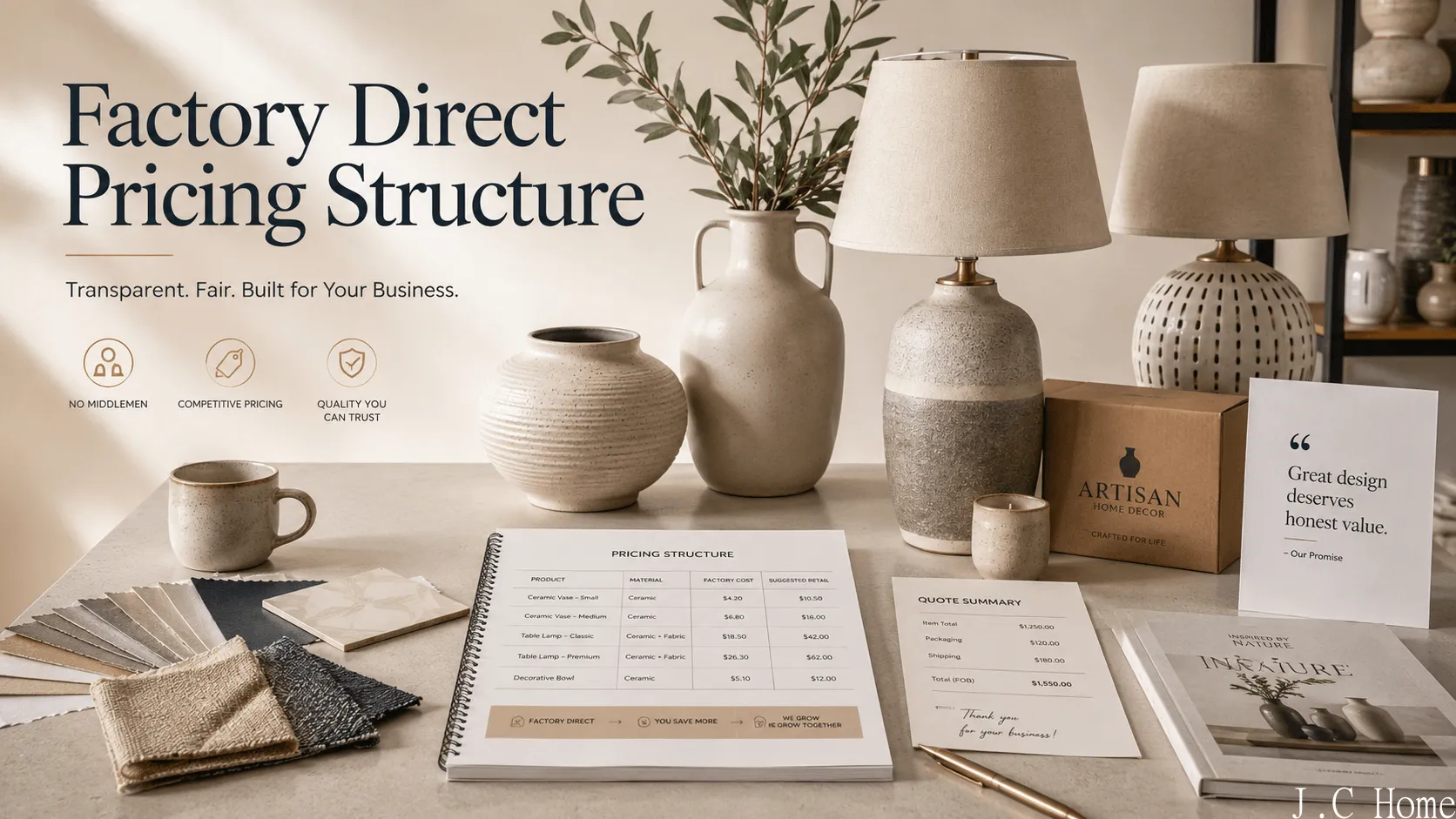
Factory direct pricing means the quotation comes from the manufacturer that controls production, materials, finishing, packing, and export coordination. Therefore, the price usually reflects the factory cost structure more directly than a distributor quotation.
However, factory direct does not mean every external cost disappears. Export freight, insurance, customs duties, taxes, warehousing, domestic delivery, and retail handling still exist. Instead, the buyer gains more visibility into where the cost is created.
For ceramic home decor wholesale, factory direct pricing usually helps buyers understand four questions:
- Which parts of the price come from ceramic body production?
- Which parts come from surface finishing, glazing, color matching, or decoration?
- Which parts come from packaging, labeling, and export preparation?
- Which parts are outside the factory price and must be estimated separately?
A useful factory quote should make the pricing model easier to review. For example, a ceramic vase with a simple matte glaze should not be evaluated the same way as a raised relief vase with custom color matching and retail box packaging.
Main Cost Layers in Ceramic Home Decor
Ceramic home decor pricing is not only about clay and labor. In practice, the final quote depends on material selection, forming method, firing loss, finish complexity, packaging method, and order structure.
The table below shows the main factory cost layers behind ceramic home decor wholesale pricing.
| Cost Layer | What It Usually Includes | Why It Changes the Price |
|---|---|---|
| Ceramic body material | Clay body, ceramic composition, additives, basic preparation | Different ceramic bodies affect forming, weight, surface feel, and firing stability |
| Forming process | Mold forming, hand-thrown style, casting, shaping, trimming | More complex shapes usually need more labor, mold control, or finishing work |
| Surface treatment | Glaze, matte finish, reactive finish, relief detail, color matching | Custom colors and layered finishes require more sampling and checking |
| Firing and loss control | Kiln firing, temperature control, defect sorting | Ceramic products can have firing variation, so factories must plan yield and inspection |
| Decoration details | Relief pattern, hand-applied finish, texture, metallic effect | Extra surface work increases process time and consistency control |
| Packaging | Inner protection, carton structure, retail box, barcode label, carton mark | Fragile ceramic items need protective packing for export and retail handling |
| OEM requirements | Logo, label, color range, size adjustment, collection development | Custom requirements add development, sampling, and approval steps |
| Export preparation | Commercial invoice, packing list, Incoterm term, basic shipment coordination | Export terms affect which costs appear in the quotation and which remain outside it |
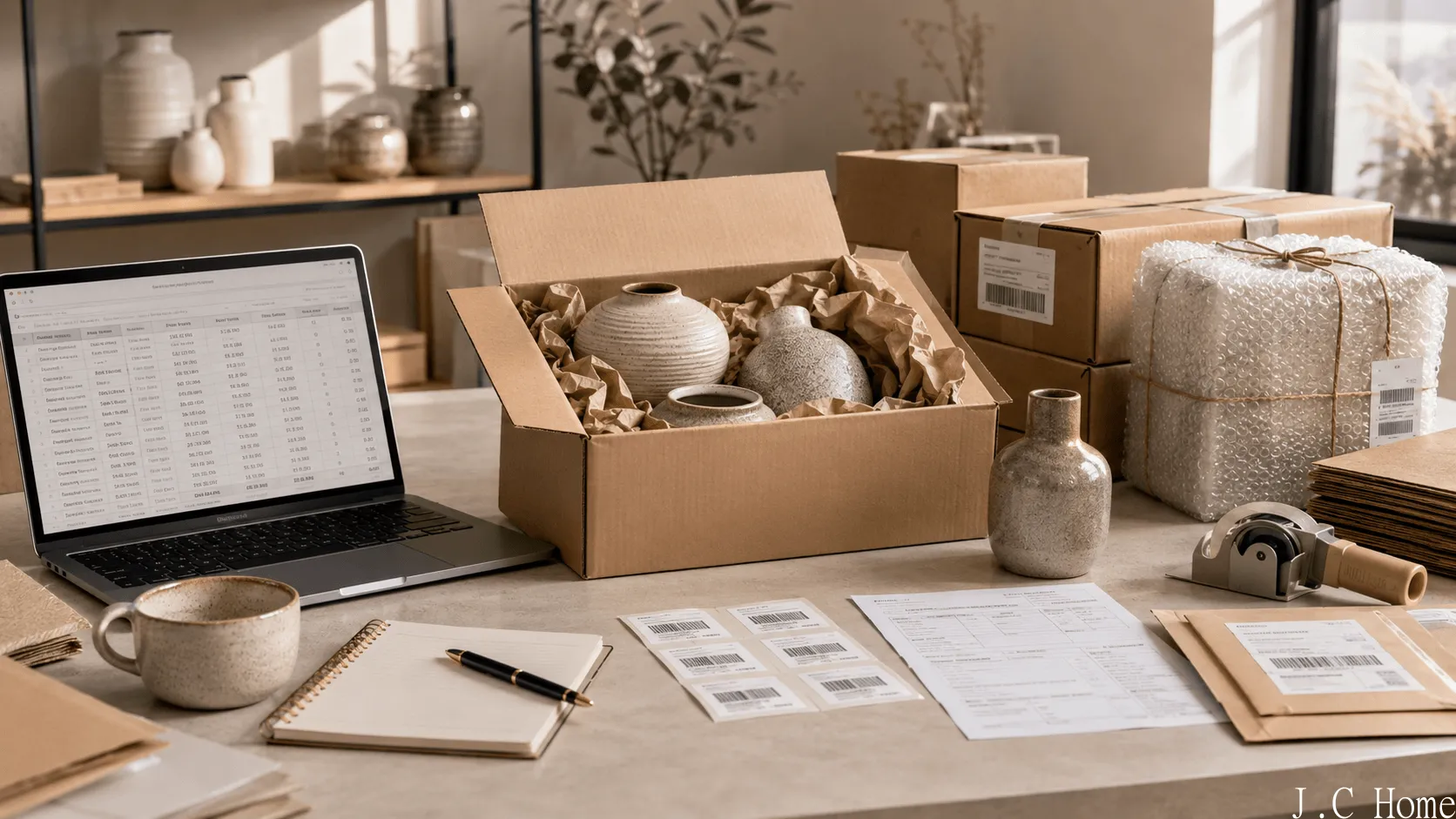
Because ceramic products are fragile and finish-sensitive, packaging and defect control should be treated as part of the pricing structure. Otherwise, a low quote may only look attractive before shipment.
For product examples, buyers can compare decorative vase structures such as ceramic vases with raised botanical relief and lighting products such as the hand-thrown ceramic table lamp. Each product type has a different cost logic because the structure, finishing, and packing needs are different.
Why OEM Pricing Is Different From Standard Wholesale Pricing
OEM pricing logic starts with the buyer’s requested changes. Therefore, a custom ceramic home decor quote cannot be judged only by comparing it with a standard catalog item.
A standard wholesale item usually uses an existing mold, existing finish, existing packing method, and known inspection process. By contrast, an OEM item may require color sampling, mold adjustment, label placement, packaging design, size change, or electrical specification confirmation for lamps.
For this reason, OEM pricing often includes hidden development work that may not appear as a separate line item. A factory may include this cost in the unit price, sample fee, mold fee, packaging charge, or project quotation.
Common OEM Pricing Drivers
| OEM Requirement | Cost Impact | Practical Buyer Question |
|---|---|---|
| Existing design with new color | Low to medium | Can the factory match the color from a Pantone code or physical sample? |
| Existing mold with new packaging | Low to medium | Does the packaging need barcode, retail box, warning label, or drop protection? |
| New shape or size | Medium to high | Does the product need a new mold or only small size adjustment? |
| Complex glaze or reactive finish | Medium to high | How much visual variation is acceptable in mass production? |
| Ceramic lamp with custom shade | Medium | Are shade size, fabric, socket, plug, and carton structure confirmed together? |
| Full retail collection | Medium to high | Can the same finish direction be used across vases, pots, lamps, and accessories? |
In addition, buyers should separate one-time development cost from repeat order cost. A first OEM order may carry more sampling and adjustment work. Later replenishment can become more stable if the design, finish, packaging, and quality standard remain unchanged.
Factory direct pricing always means the lowest final landed cost. False
Factory direct pricing can reduce intermediate markups, but freight, duties, taxes, insurance, warehousing, and handling still affect the final landed cost after export.
OEM pricing should separate development cost from repeat order logic. True
Sampling, mold adjustment, color approval, and packaging setup may affect the first order more than later replenishment, so buyers should review both stages.

Wholesale Margin Is Not the Same as Factory Cost
Wholesale margin is the difference between a seller’s cost and selling price. However, that margin does not always mean “extra profit.” It may also cover warehousing, local sales teams, inventory risk, domestic delivery, returns, finance cost, showroom display, and after-sales service.
Therefore, factory direct pricing should be compared with the service level included in the price. A distributor may charge more because it holds stock and offers local delivery. A manufacturer may quote lower because the buyer accepts export coordination and inventory planning.
The comparison below helps clarify the difference.
| Pricing Route | What the Buyer Usually Pays For | Typical Advantage | Typical Limitation |
|---|---|---|---|
| Factory direct | Production, customization, packaging, export quotation terms | More control over cost structure and product development | Buyer must manage more import, inventory, and logistics decisions |
| Trading company | Supplier coordination, communication, order follow-up | Easier communication when sourcing mixed categories | Less direct visibility into factory cost layers |
| Distributor | Local stock, warehousing, domestic delivery, faster replenishment | Convenience and shorter local lead time | Higher selling price due to inventory and service cost |
| Retail-ready program | Product, packaging, labeling, presentation support | Better for store display and private collection planning | More details must be confirmed before quotation |
A strong ceramic home decor wholesale strategy does not always choose the cheapest path. Instead, it chooses the pricing route that matches the buyer’s collection plan, cash flow, replenishment needs, and target market.
Export Pricing Changes the Real Comparison
Export pricing depends heavily on the trade term. The same ceramic vase or table lamp can look cheaper or more expensive depending on whether the quote is EXW, FOB, CIF, or another named term.
The International Trade Administration explains that Incoterms define buyer and seller responsibilities for shipment, insurance, documentation, customs clearance, and logistics activities1. As a result, buyers should never compare two unit prices without checking the named Incoterm and destination.
For example, an EXW quote may exclude inland transport, export clearance coordination, and port handling. Meanwhile, a FOB quote normally includes more origin-side steps. A CIF quote may include freight and insurance to the destination port, but it still does not mean all import duties, VAT, or destination charges are covered.
The International Trade Administration also shows that landed cost calculations can include invoice value, insurance, freight, duty, and VAT, and it recommends treating landed cost as an estimate because tariffs, taxes, and broker charges may change.Landed cost should be estimated with tariffs, taxes, freight, and insurance in mind2
Export Price Comparison Checklist
| Quote Item | Why It Matters | What to Confirm |
|---|---|---|
| Incoterm | Defines cost and risk responsibility | EXW, FOB, CIF, DAP, or another named term |
| Named place or port | A term without a place is incomplete | Factory, loading port, destination port, or delivery address |
| Product value | Used for quote comparison and import records | Unit price, total invoice value, currency |
| Packing method | Affects breakage risk and carton volume | Export carton, retail box, inner protection |
| Freight basis | Changes landed cost estimate | Sea freight, air freight, container loading, courier |
| HS code review | Helps estimate duties and taxes | Buyer should confirm with broker or customs advisor |
| Documentation | Supports customs and receiving | Commercial invoice, packing list, label information |
In addition, tariff and tax checks should not be left until the last minute. The International Trade Administration notes that buyers need the product’s Harmonized System code to determine applicable tariff and tax rates for a specific country.HS code classification is a key step in determining duty rates3
How to Read a Factory Quote More Accurately
A ceramic home decor wholesale quote should be read as a structure, not only as a unit price. Because ceramic items vary in finish, size, weight, and fragility, buyers should check whether the quote includes the right assumptions.
Start with the product itself. Confirm material, size, shape, finish, surface effect, color tolerance, and whether the item uses an existing mold. Next, review packaging, because export cartons for ceramic vases or lamps can change cost and volume.
After that, check quotation terms. The quoted price should state currency, Incoterm, named port or place, validity period, sample cost, mold cost if any, and whether packaging is standard or customized.
For U.S. imports, Customs and Border Protection explains that the commercial invoice should show the price the U.S. buyer paid for the goods, not the later resale price in the United States.Commercial invoice value should reflect the price paid for the imported goods4 Therefore, buyers should keep quotation, invoice, and payment information consistent.
Quote Review Questions for Buyers
- Does the quote use the same product size and material as the sample?
- Are finish, glaze, color, and texture clearly described?
- Does the price include standard export packaging or custom retail packaging?
- Which Incoterm and named place does the quotation use?
- Are sample cost, mold cost, and repeat order price separated?
- Does the quote mention carton size, packing quantity, and gross weight?
- For lamps, are plug, socket, voltage, shade, and market requirements confirmed?
- Has the buyer checked duties, taxes, and destination charges with a broker or freight partner?
These questions help buyers avoid false price comparisons. Moreover, they make supplier communication more efficient because the factory can quote based on clear requirements.
A lower ceramic unit price always improves wholesale margin. False
If a low price removes protective packaging, finish control, or documentation support, the buyer may face breakage, claims, delays, or higher downstream handling cost.
Clear quote assumptions make export pricing easier to compare. True
When product details, packaging, Incoterm, currency, and destination assumptions are visible, buyers can compare suppliers on a more reliable cost basis.
Building a More Stable Ceramic Pricing Model
A stable pricing model starts before the factory sends the final quote. Buyers should prepare product direction, target market, packaging needs, and order structure first. As a result, the supplier can separate standard cost from custom cost.
For ceramic decor collections, a practical pricing request should include:
- Product category, such as vase, pot, tabletop accessory, or ceramic lamp
- Target style, color direction, and finish reference
- Size range or existing product reference
- Order quantity plan and possible replenishment rhythm
- Packaging type, including export carton or retail box
- Target market, such as Europe or the United States
- Required label, barcode, carton mark, or brand presentation
- Preferred trade term and destination port if known
Meanwhile, factories can support better pricing transparency by explaining which changes affect cost most. For example, a color change may be simple if it uses an existing glaze family. However, a new shape with relief detail may require mold work, sampling, and longer approval.
JC Home Decor focuses on ceramic-led lighting and decor products, including vases, pots, tabletop accessories, table lamps, floor lamps, rechargeable lamps, and ceiling pendants. Buyers can review the company background through JC Home Decor’s factory information and explore custom lighting and decor solutions before sending a quotation request.
When a Higher Quote May Be More Reasonable
A higher quote is not always a problem. Sometimes it reflects a more complete product and export plan.
For example, ceramic items with heavier bodies, raised patterns, reactive glazes, custom retail packaging, or tighter finish matching may need more production control. In addition, lighting products require more component coordination than non-electrical decor items.
A higher quote may be reasonable when it includes:
- More protective packaging for fragile ceramic products
- Better finish consistency control for repeat orders
- Custom label, barcode, or retail box requirements
- Product development support for a coordinated collection
- Clear export documents and quotation assumptions
- Market-specific electrical specification discussion for lamps
However, buyers should ask the supplier to explain the price difference in practical terms. A useful answer should connect the price to material, process, packaging, inspection, export term, or customization work.
FAQ
What is factory direct pricing in ceramic home decor wholesale?
Factory direct pricing means the manufacturer quotes the product price based on its own production, finishing, packaging, and export assumptions. It can improve cost visibility, but buyers still need to calculate freight, duties, taxes, and destination handling.
Why do ceramic home decor wholesale prices vary so much?
Prices vary because ceramic products differ in size, weight, forming process, glaze, surface detail, firing yield, packaging, and custom requirements. A simple vase and a relief-patterned vase may have very different production costs even when they look similar in photos.
Does OEM pricing always require a new mold?
Not always. Some OEM projects only need color, label, packaging, or finish changes. However, a new shape, special size, or detailed relief surface may require mold development or extra sampling.
How does wholesale margin relate to factory cost?
Wholesale margin covers the difference between cost and selling price, but it may include warehousing, inventory risk, sales service, domestic delivery, and returns. Therefore, buyers should compare both price and service scope.
Which export term is better for ceramic home decor buyers?
There is no single answer. FOB can be practical for buyers with freight forwarders, while CIF may help buyers estimate destination port cost more easily. However, each quote should name the Incoterm and port clearly.
What should buyers prepare before asking for a factory quote?
Buyers should prepare product category, size, material, finish reference, quantity plan, packaging request, target market, and preferred export term. This helps the factory quote with fewer assumptions.
Are ceramic lamps priced the same way as ceramic vases?
No. Ceramic lamps include the ceramic body, shade, electrical components, assembly, packaging, and market specification discussion. Ceramic vases usually focus more on body shape, glaze, finish, packaging, and decorative consistency.
How can buyers compare two ceramic home decor quotes fairly?
Buyers should compare the same product specification, packaging level, Incoterm, named port, currency, sample requirement, and custom work. Otherwise, one quote may look cheaper only because it excludes important cost items.
Conclusion
Factory direct pricing in the ceramic home decor industry is most useful when buyers understand the full cost structure. A clear quote should explain product details, ceramic finish, packaging, OEM requirements, export term, and assumptions that affect landed cost.
For ceramic home decor wholesale, the goal is not simply to find the lowest unit price. Instead, buyers should build a pricing model that supports product consistency, retail presentation, repeat supply, and reliable margin planning.
If you are preparing a ceramic vase, decorative pot, tabletop accessory, or ceramic lighting collection, explore JC Home Decor’s decor collection and lighting collection. Then contact JC Home Decor with your product style, target market, quantity plan, packaging needs, and customization requirements for a more accurate quotation discussion.
References
-
International Trade Administration — Know Your Incoterms — Supports the explanation of buyer and seller responsibilities in export transactions.
↩ -
International Trade Administration — Determine Total Export Price — Supports landed cost discussion involving invoice value, freight, insurance, duties, and VAT.
↩ -
International Trade Administration — Import Tariffs & Fees Overview — Supports the need to identify HS codes when estimating duty and tax rates.
↩ -
U.S. Customs and Border Protection — Commercial Invoice Value — Supports the point that invoice value should reflect the price paid for imported goods.
↩
Buyer Checklist Before Requesting a Quote
| Information to Prepare | Why It Helps |
|---|---|
| Product category and target use | Helps confirm the right lighting or decor direction. |
| Target market | Supports electrical, packaging, labeling, and document discussion. |
| Material, color, and finish direction | Reduces misunderstanding during sample communication. |
| Packaging and label needs | Important for fragile products and retail-ready planning. |
| Reference images or collection mood | Helps align design language before quotation. |
Clear buyer information helps reduce misunderstanding before sample and order communication.