J.C Home Decor and Lighting Manufactory

Introduction
If you work with a ceramic lighting manufacturer for Europe or the United States, you need more than a nice sketch or a sample photo. You need a clear OEM workflow that connects prototype design, sample production, safety checks, packaging, and mass production process control. For retail brands, importers, and product development teams, this guide explains how a ceramic lighting collection moves from concept to repeatable supply. By the end, you will know what to prepare before contacting a factory and how JC Home Decor can support a more organised development discussion.
Why Ceramic Lighting Development Needs a Cycle
Ceramic lighting is not a simple assembly item. It combines ceramic form, glaze behaviour, electrical components, lampshade matching, packaging structure, and target-market requirements.
Therefore, an OEM product development cycle helps buyers avoid scattered decisions. Instead of approving one attractive sample too quickly, buyers can review each stage in a controlled sequence.
A clear cycle also protects the visual identity of a retail collection. For example, one table lamp may look good alone. However, a full ceramic lighting collection must keep related colours, shapes, shade proportions, and packaging logic.
At JC Home Decor, lighting development often starts with the buyer’s style direction. Then, the discussion moves into ceramic body shape, finish direction, shade matching, electrical details, and packaging needs.
Buyers can review existing options through the Lighting category before preparing a new OEM request. In addition, they can compare table lamps and rechargeable battery lamps to clarify the collection direction.

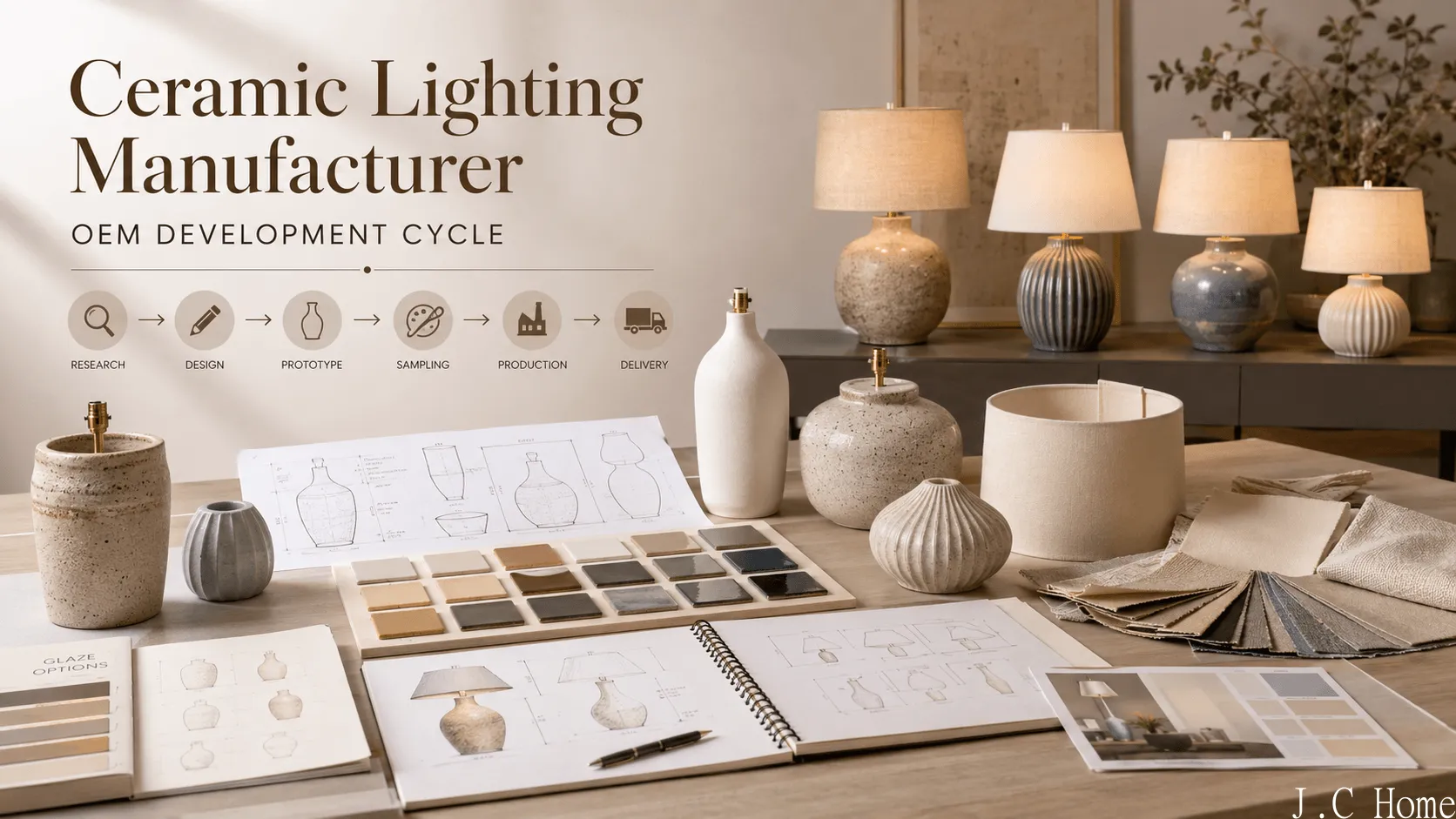
The OEM Workflow from Idea to Production
An effective OEM workflow should move from creative idea to controlled manufacturing. Each step answers a different question.
| Development Stage | Main Question | Buyer Should Prepare | Factory Should Confirm |
|---|---|---|---|
| Product brief | What market and style is the collection for? | Target market, style references, size range, channel type | Feasibility, product category, development route |
| Concept review | Can the idea become a manufacturable ceramic lamp? | Sketches, mood board, material preference | Shape limits, ceramic process, shade matching |
| Prototype design | Does the form, finish, and structure work together? | Colour direction, glaze references, lamp function | Base structure, hole position, stability, assembly logic |
| Sample production | Does the physical sample match the approved direction? | Sample comments, measurement needs, packaging idea | Finish, shade, fitting, wiring route, inspection points |
| Pre-production review | Is the design ready for repeatable production? | Approved sample, label needs, carton needs | Production standard, QC checklist, batch control |
| Mass production process | Can the collection be produced consistently? | Order plan, destination market, delivery priorities | Material preparation, firing control, assembly checks |
This structure is useful because every development stage has a gate. As a result, both buyer and manufacturer can reduce confusion before large-scale production begins.
Stage 1: Product Brief and Collection Direction
A ceramic lighting manufacturer cannot develop accurately from a short sentence such as “modern lamp needed.” Instead, the factory needs a clear product brief.
The brief does not need to be complicated. However, it should explain the market, collection style, lamp type, price positioning, and expected use.
For example, a European home decor brand may need matte neutral ceramic table lamps for calm interiors. Meanwhile, a US retailer may prefer stronger shapes, retail-ready packaging, and flexible assortment planning.
A useful product brief can include:
- Target market: Europe, United States, or another region
- Product type: table lamp, floor lamp, rechargeable lamp, or pendant
- Style direction: organic, modern, classic, textured, coastal, or colourful
- Ceramic finish: matte, glossy, reactive glaze, crackle effect, or hand-painted effect
- Shade direction: fabric shade, metal shade, natural texture, or custom colour
- Packaging request: export carton, retail box, private label packaging, or project packaging
For a broader cooperation discussion, buyers can also review JC Home Decor’s custom home decor and lighting solutions. This helps connect product development with long-term collection planning.

Stage 2: Prototype Design and Technical Feasibility
Prototype design turns the idea into a physical direction. At this stage, appearance and manufacturability must be reviewed together.
Ceramic is flexible, but it still has process limits. Large openings, thin walls, deep relief patterns, unstable bases, and complex glazing may affect production consistency.
Therefore, the factory should review shape, weight balance, firing behaviour, base stability, and assembly needs early. This is especially important for ceramic table lamps because the ceramic body must support both decoration and lamp function.
Lighting also involves electrical decisions. For many connected lamps, buyers should confirm voltage range, plug type, bulb holder, switch type, cord colour, and target-market requirements before final approval.
For European projects, buyers should check whether the product falls under the Low Voltage Directive scope1. In addition, luminaire safety discussions may refer to IEC 60598-1 general luminaire requirements2 where applicable.
These references do not replace product-specific testing advice. However, they remind buyers to treat electrical details as an early design issue, not a final paperwork task.
A beautiful prototype always means the design is production-ready. False
A prototype can prove the visual direction, but it may not prove repeatable firing, glaze stability, safe assembly, packaging strength, or batch consistency.
Technical feasibility should be reviewed before sample approval. True
Early feasibility checks help buyers avoid redesign after sampling, especially when ceramic shape, electrical parts, shade proportion, and packaging must work together.

Stage 3: Sample Production and Review
Sample production is the first real test of the OEM workflow. It checks whether the approved concept can become a physical lamp with acceptable appearance and structure.
However, one sample should not only be judged by beauty. Buyers should check finish, colour, shade fit, base balance, wiring route, switch position, packaging idea, and retail display effect.
Ceramic samples may show natural variation. For this reason, buyers should define what level of variation is acceptable for the collection.
A reactive glaze may look artistic, but it also needs a control range. Meanwhile, a solid colour finish may need closer batch matching for repeat orders.
| Sample Review Area | What to Check | Why It Matters |
|---|---|---|
| Ceramic body | Shape, thickness, surface, weight, balance | Confirms form and stability |
| Glaze finish | Colour range, texture, gloss level, variation | Controls collection consistency |
| Shade matching | Diameter, height, colour, material, fitting | Affects proportion and retail appeal |
| Electrical assembly | Cord route, switch position, bulb holder, plug direction | Supports safer and more practical use |
| Packaging concept | Protection, carton size, label direction | Reduces damage risk and improves handling |
| Market details | Voltage, plug, label, manual, safety discussion | Helps prepare for destination-market review |
During this stage, buyers should give clear comments. Vague feedback such as “make it better” can slow the sample cycle.
Instead, better feedback uses direct points. For example: “reduce shade diameter by 2 cm,” “make the glaze less glossy,” or “change the cord colour to white.”
Stage 4: Pre-Production Approval
Pre-production approval connects sampling with mass production. This stage should define what the factory must repeat.
The approved sample becomes the reference. However, buyers should also confirm measurements, finish range, shade material, packaging method, label position, and inspection criteria.
For ceramic lighting, this step is especially important because production involves several variables. Clay body, drying, firing, glaze application, assembly, and packing can all affect the final result.
Therefore, pre-production approval should include a practical control file. This does not need to be overly complex, but it should be clear enough for production and inspection teams.
A strong approval file may include:
- Product photos from multiple angles
- Confirmed dimensions and tolerance direction
- Ceramic finish reference
- Shade specification
- Electrical component direction
- Packaging structure
- Label and instruction needs
- Inspection checkpoints
- Destination market notes
For products with electrical and electronic components, buyers selling into the EU should also understand the RoHS restrictions on hazardous substances3. As a result, material and component confirmation should not wait until shipment.
Stage 5: Mass Production Process Control
The mass production process should not simply copy the sample once. Instead, it should repeat the approved standard across a batch.
Ceramic lighting production often includes material preparation, forming, drying, firing, glazing, second firing, assembly, final inspection, and packing. Each step can affect the final appearance and function.
Because ceramic firing may create natural variation, the factory should define acceptable ranges. Meanwhile, buyers should understand that handmade or reactive finishes may not look identical across every unit.
Quality control should focus on both decorative value and practical function. A lamp must look good, stand properly, assemble correctly, and arrive safely.
| Production Checkpoint | Factory Control Focus | Buyer Benefit |
|---|---|---|
| Clay preparation | Body consistency and moisture control | Reduces cracking and deformation risk |
| Forming | Shape accuracy and base balance | Keeps collection proportions stable |
| Drying and firing | Process timing and firing condition | Supports stronger ceramic structure |
| Glazing | Colour range and surface coverage | Improves visual consistency |
| Electrical assembly | Component fit and wiring route | Helps avoid functional problems |
| Final inspection | Appearance, stability, shade fit, packing | Supports sellable finished goods |
| Packaging | Protection, carton marking, retail needs | Reduces damage and improves handling |
For US distribution, household electrical product expectations should also be reviewed carefully. The U.S. Consumer Product Safety Commission household electrical guidance4 highlights safety concerns around household electrical products and decorative lighting categories.
Again, buyers should confirm the exact applicable requirements with qualified compliance partners. However, the development team should raise these questions before mass production starts.
Packaging can be finalised after mass production. False
Packaging affects carton size, protection, labelling, inspection, and shipping preparation. Therefore, it should be discussed before production approval.
A repeatable mass production process needs clear sample standards. True
Approved samples, finish references, packaging files, and inspection points help the factory repeat the intended design more consistently across future orders.
How Buyers Can Reduce Development Revisions
OEM lighting development becomes smoother when buyers prepare clear information early. A manufacturer can then judge feasibility faster and ask better questions.
Before requesting a quote, buyers should prepare the following details:
| Requirement Type | Useful Information to Send | Development Value |
|---|---|---|
| Product direction | Lamp type, style reference, size range | Helps define the starting point |
| Ceramic finish | Colour, glaze effect, surface texture | Guides prototype design |
| Function | Plug-in lamp, rechargeable lamp, switch type | Shapes component selection |
| Target market | Europe, United States, or other region | Supports compliance discussion |
| Packaging | Retail box, export carton, private label | Reduces late-stage changes |
| Collection plan | Number of styles, related shapes, repeat order idea | Supports long-term consistency |
| Review method | Photos, physical samples, approval files | Speeds up decision-making |
Clear preparation also improves supplier communication. Instead of asking for a general price first, buyers can begin with a complete project direction.
For example, a buyer can say: “We need a six-style ceramic table lamp collection for the EU market, using matte neutral finishes, fabric shades, retail cartons, and private label packaging.”
This type of request gives the manufacturer a better foundation. As a result, the discussion can move from guessing to practical development.
OEM Development for Different Lighting Categories
Not every lighting product follows the same development path. A ceramic table lamp, rechargeable lamp, floor lamp, and ceiling pendant each require different checks.
Ceramic table lamps usually focus on body shape, glaze, shade proportion, base stability, and wiring route. Therefore, sample review should pay close attention to scale and finish control.
Rechargeable battery lamps add battery, charging port, usage environment, and component selection questions. Because of this, buyers should clarify the intended market and application before confirming structure.
Floor lamps involve height, base weight, metal or ceramic combinations, shade proportion, and carton strength. Meanwhile, ceiling pendants require more careful installation and component discussions.
JC Home Decor covers multiple lighting categories, including table lamps, floor lamps, rechargeable battery lamps, and ceiling pendants. Buyers can start from the Lighting page and then send development requirements through the Contact Us page.
When to Involve the Manufacturer Early
Some buyers wait until their design is fully finished before speaking with a factory. However, this can create avoidable revisions.
Early manufacturer input helps identify ceramic process limits, structural risks, packaging concerns, and market-related details. Moreover, it helps buyers understand whether an existing product can be adapted instead of starting from zero.
For example, a brand may want a new ceramic lamp shape. After discussion, the factory may suggest adjusting the base diameter for stability or simplifying a relief pattern for better production consistency.
This does not mean the brand loses design control. Instead, early technical review protects the design from problems later in the development cycle.
Buyers who want to understand JC Home Decor’s factory and product background can review the About Us page before sending project details.
FAQ
What is an OEM product development cycle for ceramic lighting?
An OEM product development cycle is the step-by-step process that turns a buyer’s concept into a producible ceramic lighting collection. It usually includes product brief, prototype design, sample production, pre-production approval, mass production, inspection, and packaging confirmation.
How long does ceramic lighting development take?
The timeline depends on product complexity, sample revisions, ceramic finish, component needs, and buyer approval speed. Therefore, buyers should confirm timing directly with the manufacturer instead of assuming one fixed schedule.
Why is prototype design important for ceramic lamps?
Prototype design helps test shape, proportion, glaze direction, stability, and assembly logic before production. In addition, it allows buyers to adjust visual details before investing in a full production batch.
What should buyers check during sample production?
Buyers should review ceramic body shape, colour, glaze effect, shade fit, stability, electrical layout, packaging idea, and target-market details. Clear comments help the factory revise the sample more accurately.
Can one approved sample represent the full mass production batch?
One approved sample is important, but it should be supported by written specifications and acceptable variation ranges. This is especially true for ceramic finishes because firing and glazing may create natural differences.
Should electrical requirements be discussed before or after the design sample?
Electrical requirements should be discussed early. Plug type, voltage, switch, cord route, charging needs, and market expectations can affect structure, assembly, packaging, and compliance planning.
How can retail brands keep a ceramic lighting collection consistent?
Retail brands should define a style family, finish range, shade logic, packaging format, and repeat order standard. As a result, future orders can follow the same collection identity more easily.
What information should be sent to JC Home Decor for an OEM request?
Buyers can send product references, target market, lamp type, dimensions, finish direction, shade needs, packaging requirements, and expected order plan. Then, JC Home Decor can review the request and discuss the next development steps.
Conclusion
A ceramic lighting manufacturer should guide OEM development through a clear cycle, not through random sample changes. The strongest process connects product brief, prototype design, sample production, pre-production approval, mass production process control, and packaging planning.
For buyers in Europe, the United States, and other export markets, early confirmation matters. Ceramic finish, lamp structure, electrical details, packaging, and inspection standards should all be reviewed before mass production.
If you are developing ceramic table lamps, rechargeable lamps, floor lamps, or ceiling pendants, explore JC Home Decor’s Lighting collection and prepare your project brief. Then, send your style references, target market, product category, finish direction, and packaging needs through the Contact Us page for a focused OEM discussion.
References
-
European Commission — Low Voltage Directive — Supports the discussion of voltage scope and EU electrical safety considerations for lighting products.
↩ -
IEC — IEC 60598-1 Luminaires General Requirements and Tests — Supports the mention of general luminaire safety requirements and product development checks.
↩ -
European Commission — RoHS Directive — Supports hazardous substance restriction considerations for electrical and electronic equipment.
↩ -
U.S. Consumer Product Safety Commission — Household Electrical Products — Supports the discussion of US household electrical product safety concerns.
↩
Buyer Checklist Before Requesting a Quote
| Information to Prepare | Why It Helps |
|---|---|
| Product category and target use | Helps confirm the right lighting or decor direction. |
| Target market | Supports electrical, packaging, labeling, and document discussion. |
| Material, color, and finish direction | Reduces misunderstanding during sample communication. |
| Packaging and label needs | Important for fragile products and retail-ready planning. |
| Reference images or collection mood | Helps align design language before quotation. |
Clear buyer information helps reduce misunderstanding before sample and order communication.