J.C Home Decor and Lighting Manufactory


Introduction
You may already work with a lighting and decor supplier for lamps, vases, pots, or tabletop accessories.
Your retail packaging, however, decides whether those products arrive safely, look organised on the shelf, and support your brand story.
When you sell in Europe or the United States, packaging also needs to consider transport protection, barcode readability, environmental claims, and local market expectations.
For this reason, this article explains how home decor exporters and retail partners can build a retail-ready packaging system for lighting and decor collections.
What Retail-Ready Packaging Really Means
Retail-ready packaging is not only a nice printed box.
Instead, it is a complete system that connects product protection, retail presentation, shelf handling, product information, and brand consistency.
For lighting and decor products, this system matters because the items often include fragile ceramic bodies, fabric shades, glass details, metal hardware, or decorative finishes.
Therefore, packaging should answer five practical questions before production begins:
- Can the product survive export handling?
- Does the box fit the retail shelf or stockroom?
- Can store staff identify the SKU quickly?
- Does the packaging support the brand’s visual direction?
- Can the buyer confirm market information before shipment?
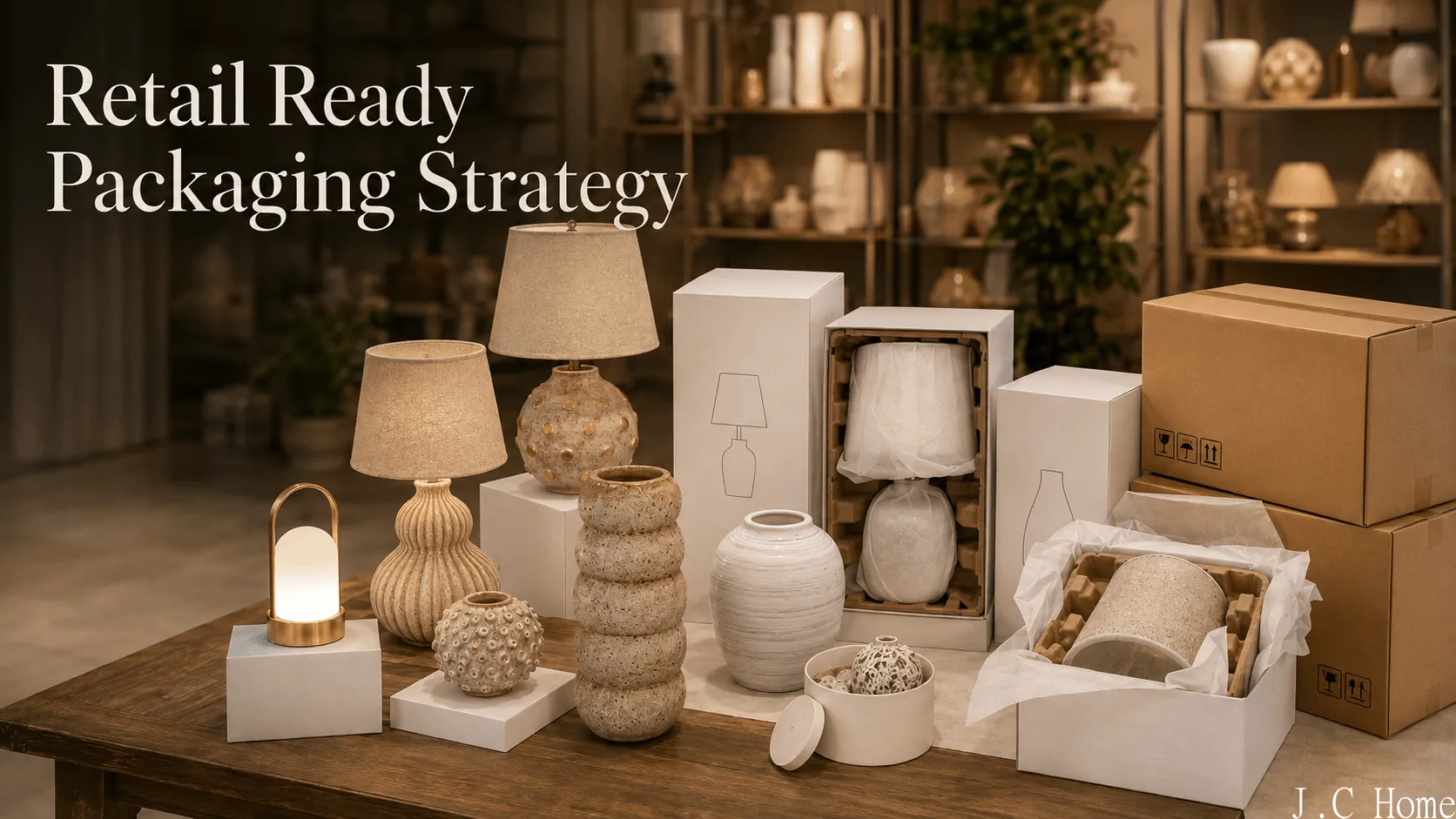
JC Home Decor supports lighting and decor collections such as ceramic table lamps, rechargeable lamps, ceramic vases, pots, and tabletop accessories. Because these categories often enter retail channels as coordinated collections, packaging should be planned as a brand system rather than a single box design.
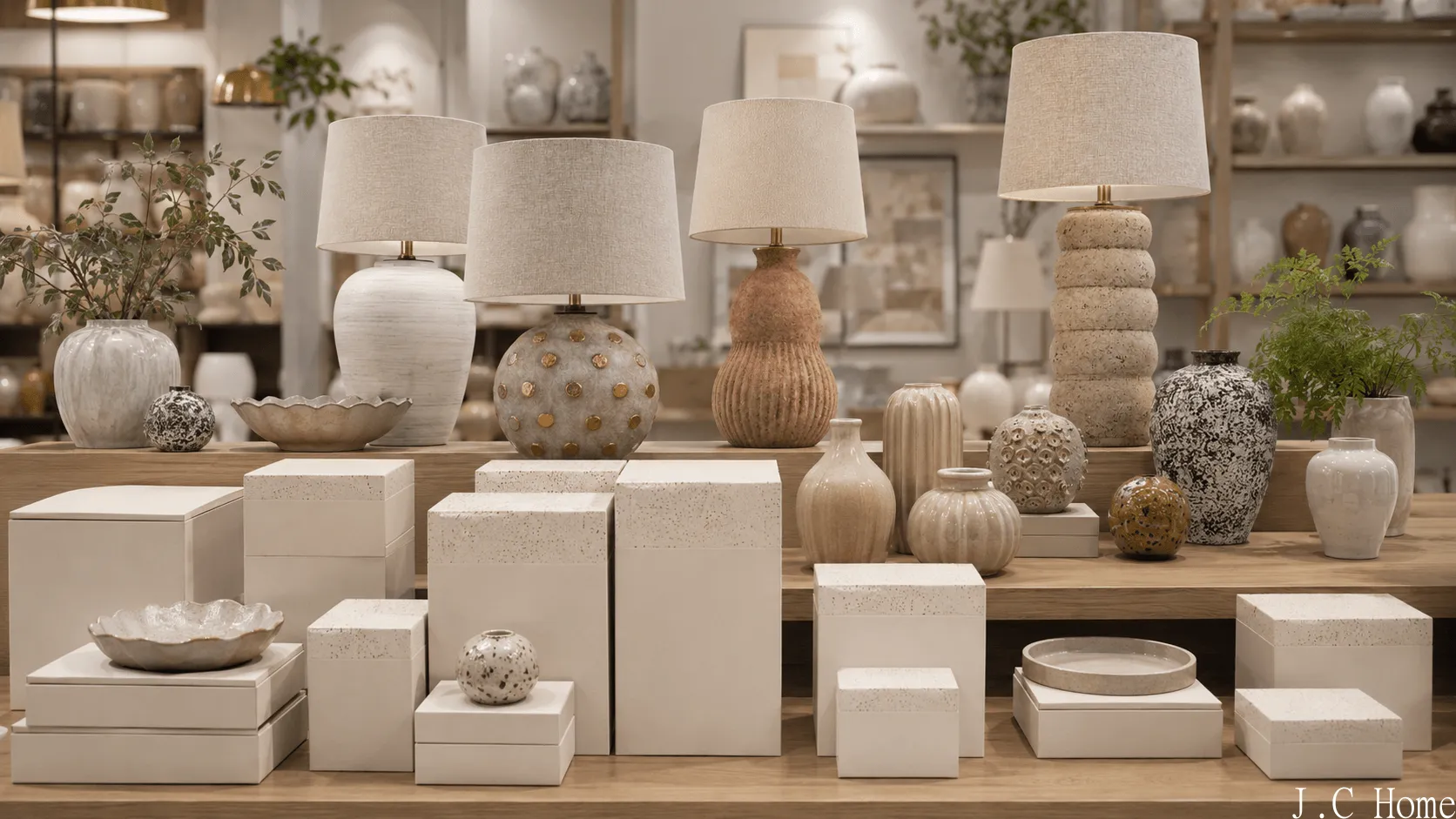
Packaging Layers for Lighting and Decor
A strong packaging plan begins with layers.
Each layer has a different job. In addition, each layer affects cost, storage, handling, and customer experience.
| Packaging Layer | Main Function | Retail Strategy |
|---|---|---|
| Product contact layer | Protects surfaces from scratches, dust, and rubbing | Use soft wrapping for glazed ceramic, metal finish, glass, or painted surfaces |
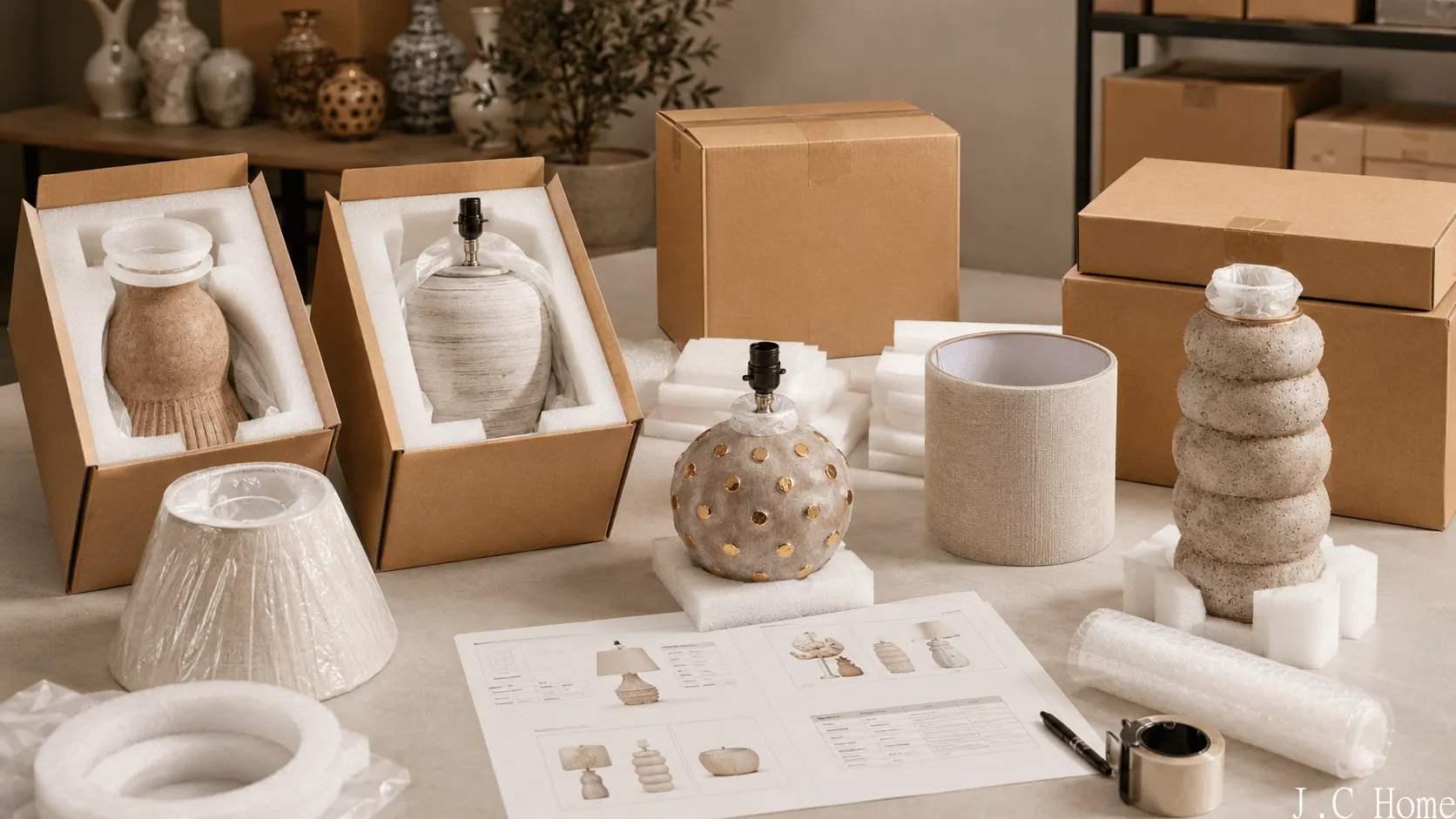
| Inner protection layer | Controls shock, movement, and pressure | Match inserts to the product shape, shade size, and fragile points |
| Retail box | Presents product information and brand design | Keep layout clean, scannable, and consistent across product families |
| Master carton | Supports export handling and warehouse storage | Mark SKU, quantity, orientation, and handling notes clearly |
| Pallet or outer shipment system | Improves container loading and warehouse movement | Confirm carton strength, stacking direction, and mixed-SKU loading needs |
For example, a ceramic table lamp may need separate protection for the ceramic body, lampshade, metal finial, and cord set.
Meanwhile, a ceramic vase collection may need insert structures that protect the rim, shoulder, and base from impact.
Because lighting and decor products vary in shape, buyers should avoid using one generic packaging structure for every item.
Why Packaging Design Affects Retail Presentation
Retail buyers do not only evaluate the product inside the box.
They also consider how the product looks when it arrives, how quickly staff can process it, and whether the packaging supports the store’s visual identity.
As a result, packaging design should stay consistent across product series.
A lighting collection, for instance, may use the same box structure and brand layout while changing product photos, colour names, and SKU information.
Similarly, a ceramic vase series can use one packaging identity across multiple sizes.
This approach helps retailers organise shelves, stockrooms, and online product data more easily.
| Retail Presentation Element | Why It Matters | Practical Packaging Decision |
|---|---|---|
| Front panel design | Helps buyers and staff recognise the product quickly | Use clean product image, product name, and series identity |
| Side panel information | Supports shelf storage and warehouse picking | Add SKU, size, colour, barcode zone, and handling icons |
| Colour system | Helps separate product families | Use controlled colour bands or collection labels |
| Product image | Reduces confusion when cartons are closed | Use realistic images that match the final finish |
| Brand layout | Supports private label consistency | Keep logo position, typography, and spacing stable |
In addition, retail-ready packaging should not overdesign the box.
A crowded layout can reduce readability, especially when stores process many cartons at once.
Therefore, a clean brand packaging system usually works better than a decorative box filled with excessive visual elements.
Retail-ready packaging only means printed colour boxes. False
Retail-ready packaging also includes inner protection, carton information, shelf handling, barcode placement, and product identification. A beautiful box can still fail if it does not protect the item.
A consistent packaging system supports repeat retail orders. True
When product families share a clear packaging language, retailers can manage display, stockroom sorting, and replenishment with less confusion across multiple SKUs.
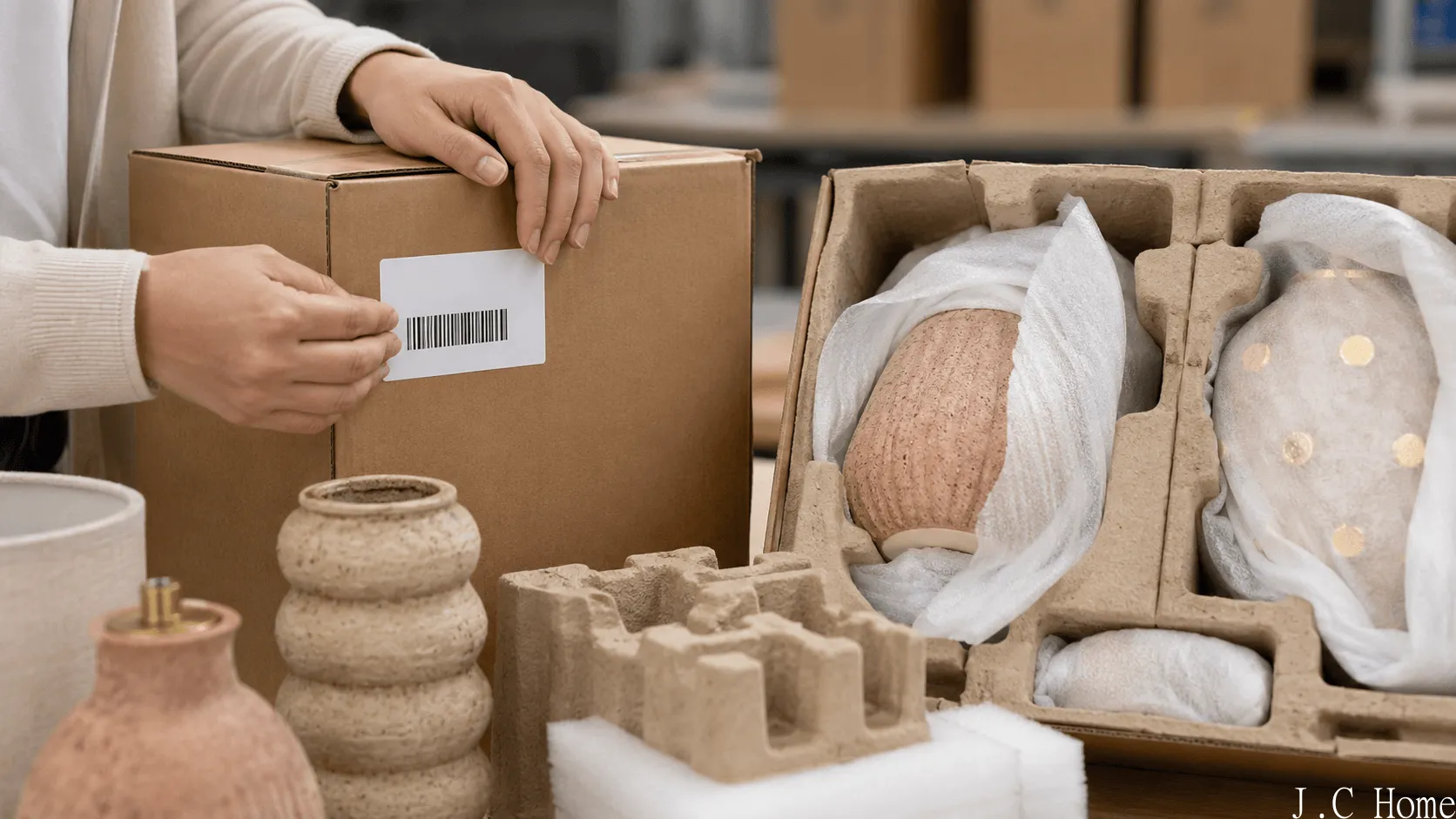
Export Packaging Must Protect the Product First
Export packaging should protect the product before it supports the shelf.
This point is especially important for ceramic lighting and decor because the surface finish is part of the product value.
According to the International Safe Transit Association test procedure overview1, different package tests can screen package integrity or simulate distribution hazards.
For buyers, this does not mean every order needs the same test plan.
However, it does mean packaging should be discussed based on product fragility, sales channel, shipping route, and handling method.
A fragile ceramic table lamp may need stronger corner protection than a compact tabletop accessory.
Likewise, a large floor lamp carton may need a different structure from a small rechargeable lamp box.
Before mass production, buyers can ask their supplier to confirm:
- Product weak points
- Inner insert material
- Drop and vibration concerns
- Carton stacking direction
- Carton marking requirements
- Mixed-SKU loading plan
- Retail box artwork approval
- Master carton information
JC Home Decor can discuss packaging needs together with product requirements when buyers prepare custom lighting and decor projects.
Shelf-Ready Packaging and Product Information
Shelf-ready packaging should help retail teams move products from carton to display faster.
For lighting and decor, shelf-ready does not always mean the product must stay inside an open display box.
Sometimes it means the packaging is easy to identify, easy to open, and easy to restock.
Barcode and product information planning is also important.
GS1 guidance for retail point-of-sale barcodes2 discusses barcode placement, human-readable text, and retail scanning considerations.
Therefore, buyers should leave a proper barcode zone during artwork planning instead of adding codes at the last minute.
| Information Area | What to Prepare | Why It Helps Retail Teams |
|---|---|---|
| Product name | Clear item name and series name | Reduces confusion between similar designs |
| SKU and variant | Model, colour, size, or finish | Supports warehouse and store sorting |
| Barcode zone | GTIN or retailer barcode placement | Helps point-of-sale and inventory systems |
| Handling marks | Fragile, upward direction, dry storage | Reduces avoidable handling mistakes |
| Market text | Required language or label content | Supports local retail requirements |
| Brand details | Logo, collection name, care note | Improves brand recognition and customer confidence |
For private label projects, the buyer should confirm whether the packaging needs retailer barcodes, brand barcodes, or both.
Moreover, online retailers may also need product images, carton dimensions, and packaging weight for listing and fulfilment.
Brand Packaging System for Product Collections
A brand packaging system helps different product categories look connected.
This is useful when a retailer sells ceramic table lamps, rechargeable lamps, vases, pots, and tabletop accessories under one seasonal or lifestyle collection.
Rather than redesigning each box from zero, the supplier and buyer can create a shared packaging framework.
The framework may include:
- Logo placement
- Front panel image rules
- Collection name area
- Colour code system
- SKU information grid
- Barcode and label area
- Care and handling notes
- Master carton label format
For example, a buyer may use one visual system for a “natural ceramic texture” collection.
Within that system, the table lamp box, vase box, and decorative pot box can share the same typography and layout.
However, each product still needs its own protective structure.
This balance helps the packaging look unified while respecting product differences.
Buyers reviewing ceramic decor items such as wholesale ceramic vases can prepare packaging references together with colour, finish, and size requirements.
Packaging and Environmental Claims
Packaging sustainability is becoming more important, especially in Europe and the United States.
However, buyers should separate real packaging requirements from vague marketing claims.
The European Commission explains that the Packaging and Packaging Waste Regulation3 covers packaging and packaging waste regardless of material or origin and sets requirements for manufacturing, composition, and recoverability.
In the United States, the FTC’s Green Guides4 are designed to help marketers avoid misleading environmental claims.
Therefore, packaging copy should avoid broad claims such as “eco-friendly” unless the buyer can support the statement.
A safer approach is to describe specific materials or actions after confirmation.
For instance, buyers may confirm paperboard type, plastic reduction goals, recyclable material claims, or local label requirements before printing.
The U.S. EPA also notes that containers and packaging are used for shipping, storage, protection, and sales or marketing benefits, while making up a significant part of municipal solid waste in its reported data.5
Because of this, packaging strategy should consider protection and material responsibility together.
A greener-looking package automatically supports compliance. False
Natural colours, leaf graphics, or kraft paper textures do not prove environmental performance. Buyers should confirm material claims and market requirements before printing packaging copy.
Specific packaging claims are safer than vague claims. True
Statements about material content, recyclability, or reduced plastic should be confirmed with the target market and supplier before artwork approval.
Packaging Brief for Retail Buyers
A packaging brief helps the supplier understand what the buyer needs before artwork or sampling begins.
It also reduces repeated revisions.
Instead of only sending a logo file, buyers should prepare product, channel, and market details.
| Brief Item | What Buyers Should Send | Why It Matters |
|---|---|---|
| Product category | Table lamp, floor lamp, vase, pot, or accessory | Different shapes need different protection |
| Target market | Europe, United States, or another market | Label content and claims may differ |
| Retail channel | Store shelf, online store, showroom, or gift channel | Packaging size and presentation needs change |
| Brand assets | Logo, colours, fonts, image style | Supports consistent brand packaging |
| Product data | SKU, size, colour, finish, material | Helps build accurate box panels |
| Barcode needs | GS1 code, retailer code, or temporary label | Prevents late-stage artwork issues |
| Protection priority | Fragile rim, ceramic body, shade, hardware, glass | Guides insert and carton structure |
| Sustainability direction | Material preference or claim restrictions | Avoids unsupported environmental wording |
For lighting items, buyers should also confirm whether the package needs space for accessories such as bulbs, charging cables, remotes, instruction sheets, or spare parts.
In addition, product teams should confirm whether packaging will support retail display, direct shipment, or warehouse storage.
These uses may require different carton structures.
How Suppliers Support Retail-Ready Packaging
A reliable supplier should not treat packaging as an afterthought.
Instead, the packaging process should run beside product development.
For example, when a ceramic lamp body changes shape, the insert may also need adjustment.
Likewise, when a vase series adds a new size, the master carton plan may need review.
A capable lighting and decor supplier can support the packaging process in several ways:
- Check product dimensions before box structure planning
- Discuss inner protection based on fragile points
- Support private label layout and packaging artwork
- Coordinate retail box and master carton information
- Prepare product series packaging consistency
- Help buyers organise packaging requirements before quotation
JC Home Decor works with lighting and decor products across table lamps, floor lamps, rechargeable lamps, ceiling pendants, vases, pots, and tabletop accessories. Buyers can also review the company background through About JC Home Decor before sending packaging and product development requirements.
Common Packaging Mistakes to Avoid
Retail packaging problems often happen before production starts.
Sometimes the product is approved, but the package is not reviewed carefully enough.
As a result, the buyer may face unclear carton markings, weak inserts, missing barcode space, or artwork that does not match the product series.
To reduce risk, buyers should avoid these common mistakes:
- Approving packaging artwork before confirming final product size
- Using one insert structure for different fragile shapes
- Placing barcode areas where folds or curves affect scanning
- Printing unsupported environmental claims
- Ignoring master carton labels until shipment preparation
- Treating retail box design and export protection as separate tasks
- Forgetting online listing needs such as carton size and product photo accuracy
For this reason, packaging should be part of the quotation discussion.
Buyers can send product category, target market, packaging reference, retail channel, and brand files through the JC Home Decor Contact Us page.
FAQ
What is retail-ready packaging for home decor products?
Retail-ready packaging is a packaging system designed for protection, shelf handling, product identification, and brand presentation. For home decor products, it should protect fragile surfaces while helping retailers display, store, and restock products efficiently.
Why does a lighting and decor supplier need packaging details early?
Packaging details affect quotation, sampling, carton size, product protection, and retail presentation. Therefore, buyers should discuss packaging before mass production rather than after product approval.
Is shelf-ready packaging the same as export packaging?
No. Shelf-ready packaging focuses on retail display, handling, and identification. Export packaging focuses on transport protection, stacking, and damage reduction. For lighting and decor, both functions should work together.
What information should be included on retail packaging?
Retail packaging may include product name, SKU, size, colour, barcode, brand details, handling notes, care information, and market-specific text. However, buyers should confirm final requirements based on their target market and retail channel.
Can packaging be customised for private label home decor collections?
Yes, packaging can usually be customised with logo, colour system, product image style, collection name, label layout, and carton information. However, the structure should still match product shape and protection needs.
How can buyers avoid misleading environmental claims?
Buyers should avoid broad claims unless they can support them. In addition, they should confirm material information, local rules, and claim wording before printing packaging artwork.
What should buyers send before requesting packaging support?
Buyers should send product category, target market, retail channel, brand files, packaging reference, SKU list, barcode needs, and protection concerns. This information helps the supplier prepare a more accurate packaging plan.
Conclusion
Retail-ready packaging helps home decor exporters connect product protection, retail presentation, brand identity, and market readiness.
For lighting and decor collections, packaging should be planned as a system because ceramic lamps, vases, pots, and accessories each need different protection while sharing a consistent visual language.
Therefore, buyers should prepare product details, target market needs, packaging references, barcode requirements, and brand files before confirming samples or repeat orders.
If you are developing retail-ready lighting and decor collections, you can review JC Home Decor’s lighting product category or send your product and packaging requirements through the custom quote page.
References
-
International Safe Transit Association — Test Procedures — Supports the discussion of package integrity screening and distribution hazard simulation for export packaging decisions.
↩ -
GS1 — 2D Barcodes at Retail Point-of-Sale Implementation Guideline — Supports the discussion of barcode placement, human-readable text, and retail scanning considerations.
↩ -
European Commission — Packaging Waste — Supports the section on EU packaging rules, recyclability direction, and packaging life-cycle requirements.
↩ -
Federal Trade Commission — Green Guides — Supports the recommendation to avoid misleading environmental marketing claims on packaging.
↩ -
U.S. EPA — Containers and Packaging Product-Specific Data — Supports the explanation that packaging provides shipping, storage, protection, and sales or marketing benefits.
↩
Buyer Checklist Before Requesting a Quote
| Information to Prepare | Why It Helps |
|---|---|
| Product category and target use | Helps confirm the right lighting or decor direction. |
| Target market | Supports electrical, packaging, labeling, and document discussion. |
| Material, color, and finish direction | Reduces misunderstanding during sample communication. |
| Packaging and label needs | Important for fragile products and retail-ready planning. |
| Reference images or collection mood | Helps align design language before quotation. |
Clear buyer information helps reduce misunderstanding before sample and order communication.