J.C Home Decor and Lighting Manufactory

Introduction
Tabletop decor for entryway consoles works best when it makes the arrival area feel considered without taking away the surface people actually need. By the end of this guide, retailers, designers, and collection teams will have a practical method for balancing an anchor object, a lamp, supporting accessories, and usable landing space.
The approach applies to residential entryways, styled retail displays, and collection-development presentations for European and U.S. markets. It is a visual planning method, not a substitute for confirmed product dimensions, materials, care instructions, packaging, or electrical details.
Start with the Entryway’s Real Job
An entryway console is both a visual threshold and a working surface. Before choosing decor, list what the furniture must hold during a normal day: keys, a small bag, mail, or nothing at all. The answer determines how much of the top can become a permanent display.
The safest starting point is to reserve one clear landing zone. Then place the main decorative group outside that zone. A narrow console needs more editing than a deep sideboard because every object competes with circulation and usable depth.
Every console should be filled from edge to edge. False.
Open surface space keeps the entry functional and makes the selected objects easier to read.
The viewing direction changes the composition. True.
Review the console from the doorway, the room, and the main walking path before finalizing the arrangement.
Choose One Anchor Object
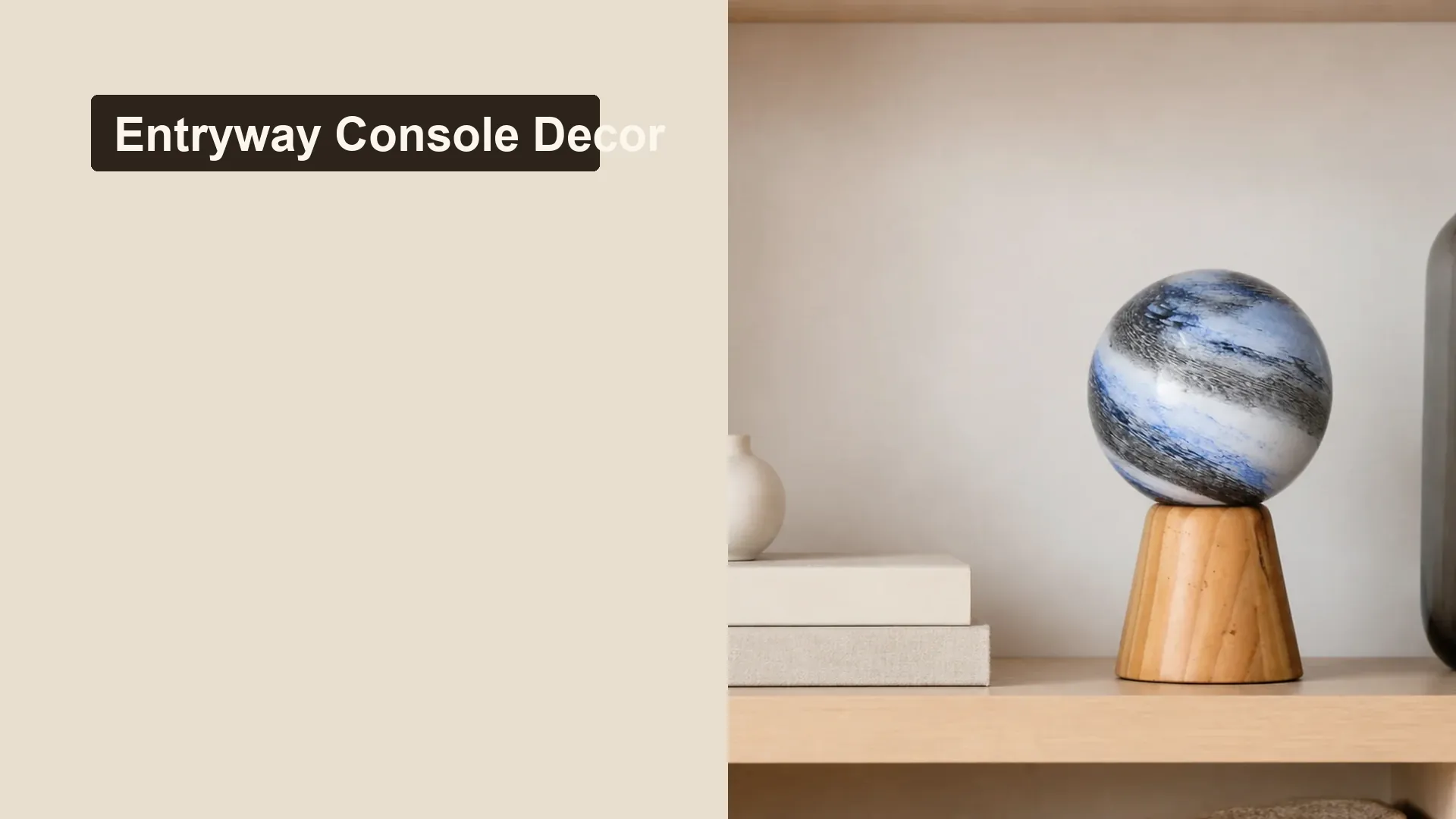
The anchor gives the console a visual center. It might lead through silhouette, pattern, color, or height. A sculptural object can perform this role without flowers or additional ornament, especially when its outline remains visible against a calm wall.
Explore Table Top Accessories for object-led directions and compare them with the wider Decor collection. Related Vases and Decorative Pots can support the same display when their actual function and material descriptions are confirmed.
| Anchor decision | Useful direction | Common risk |
|---|---|---|
| Strong pattern | Keep nearby objects quiet and mostly solid | Several patterns competing at eye level |
| Rounded silhouette | Add one low horizontal support | Repeating only round forms |
| Dark visual weight | Use more open space around it | One end of the console feeling heavy |
| Glossy surface | Pair with matte or textile texture | Excess reflection across the whole display |

Balance a Lamp and Accessories without Forced Symmetry
A table lamp can establish height and evening warmth, while a lower accessory group balances its visual mass. The two sides do not need to match. Instead, compare their combined width, color intensity, and empty space.
If the lamp shade is broad, use fewer objects on the opposite side. If the accessory has a strong pattern, select a quieter lamp body or shade. Browse Table Lamps for related lighting directions, then review the broader Lighting collection when developing a coordinated assortment.
| Lamp condition | Accessory response | Planning note |
|---|---|---|
| Tall, narrow lamp | Low tray and one medium object | Keep the height contrast clear |
| Broad shade | Compact accessory group | Protect usable surface width |
| Patterned lamp body | Solid-color supporting objects | Avoid competing focal points |
| Neutral lamp | One controlled color accent | Repeat the accent only once |
Coordinate Color and Material with Restraint
Entryway displays are often seen quickly, so one repeated cue is usually enough. A blue accent may reappear in a bowl, artwork, or nearby textile. A natural wood base can connect with the console finish, but the tones do not need to match exactly.
Use contrast to separate silhouettes: glossy beside matte, pale beside dark, smooth beside textured. Do not infer real wood, ceramic, marble, or rattan from appearance alone. Accurate retail and website copy must follow confirmed product information.
All materials must match. False.
A repeated color, curve, or finish can connect mixed materials without making the display flat.
Screen color needs sample confirmation. True.
Lighting, screens, glaze, texture, finish, and natural variation can change how a color appears.
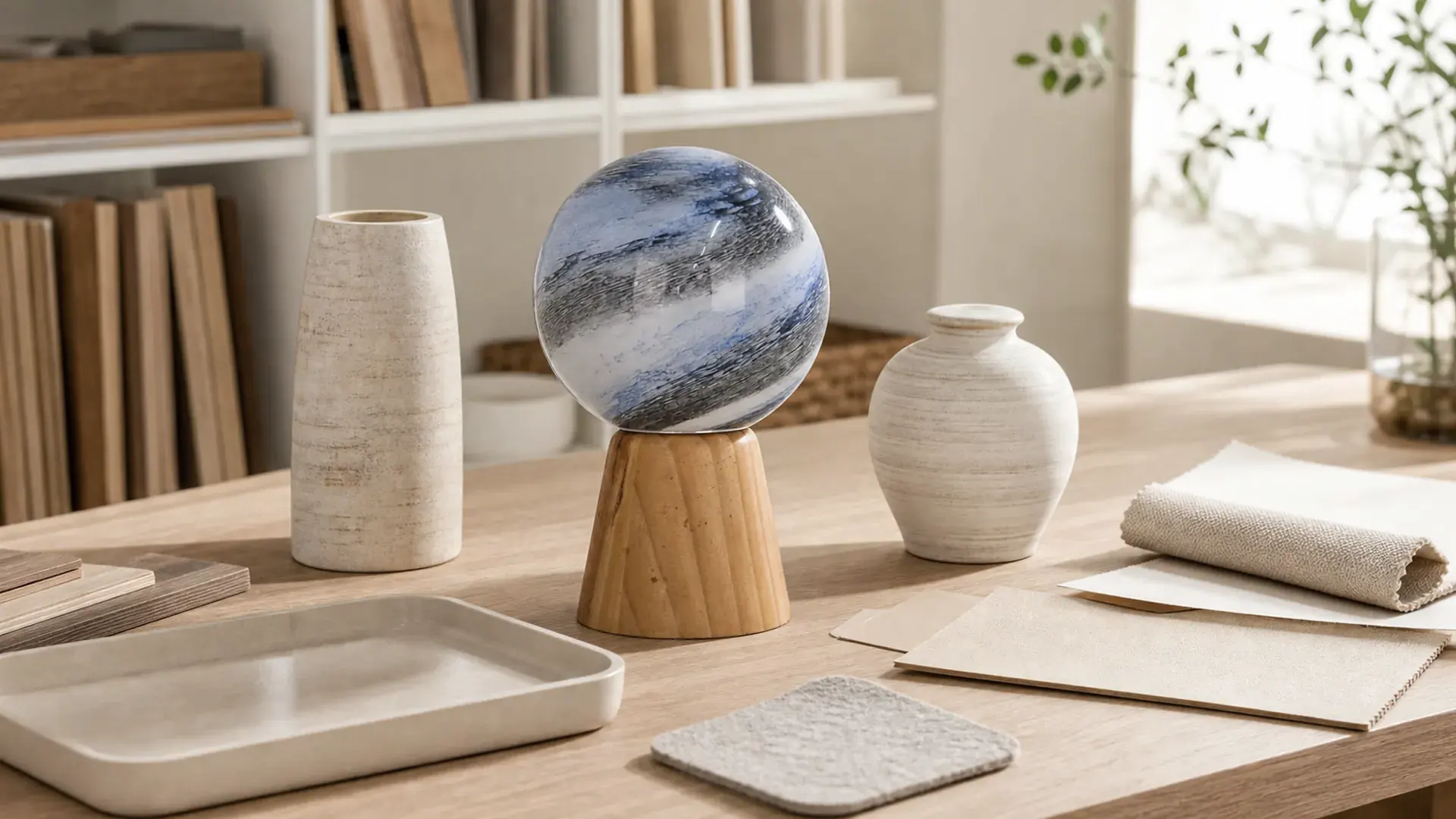
Practical Tool: Entryway Console Space Map
Use this tool before styling a room, planning a retail photograph, or briefing a product collection. Draw the console as a rectangle and divide it into four working zones.
| Zone | Question | Record |
|---|---|---|
| Anchor zone | Which object leads the composition? | Product reference and approximate footprint |
| Height zone | Is a lamp, artwork, or tall object creating vertical structure? | Height relationship and sightline |
| Support zone | Which one or two objects connect color or material? | Supporting roles only |
| Landing zone | What surface must remain free in daily use? | Minimum clear width and depth |
Score each zone from 0 to 2: 0 = unresolved, 1 = partly clear, and 2 = clear. A strong plan normally has a recognizable anchor and a protected landing zone. If the score is low, remove one object before adding another.
Adapt the Look into a Coordinated Collection
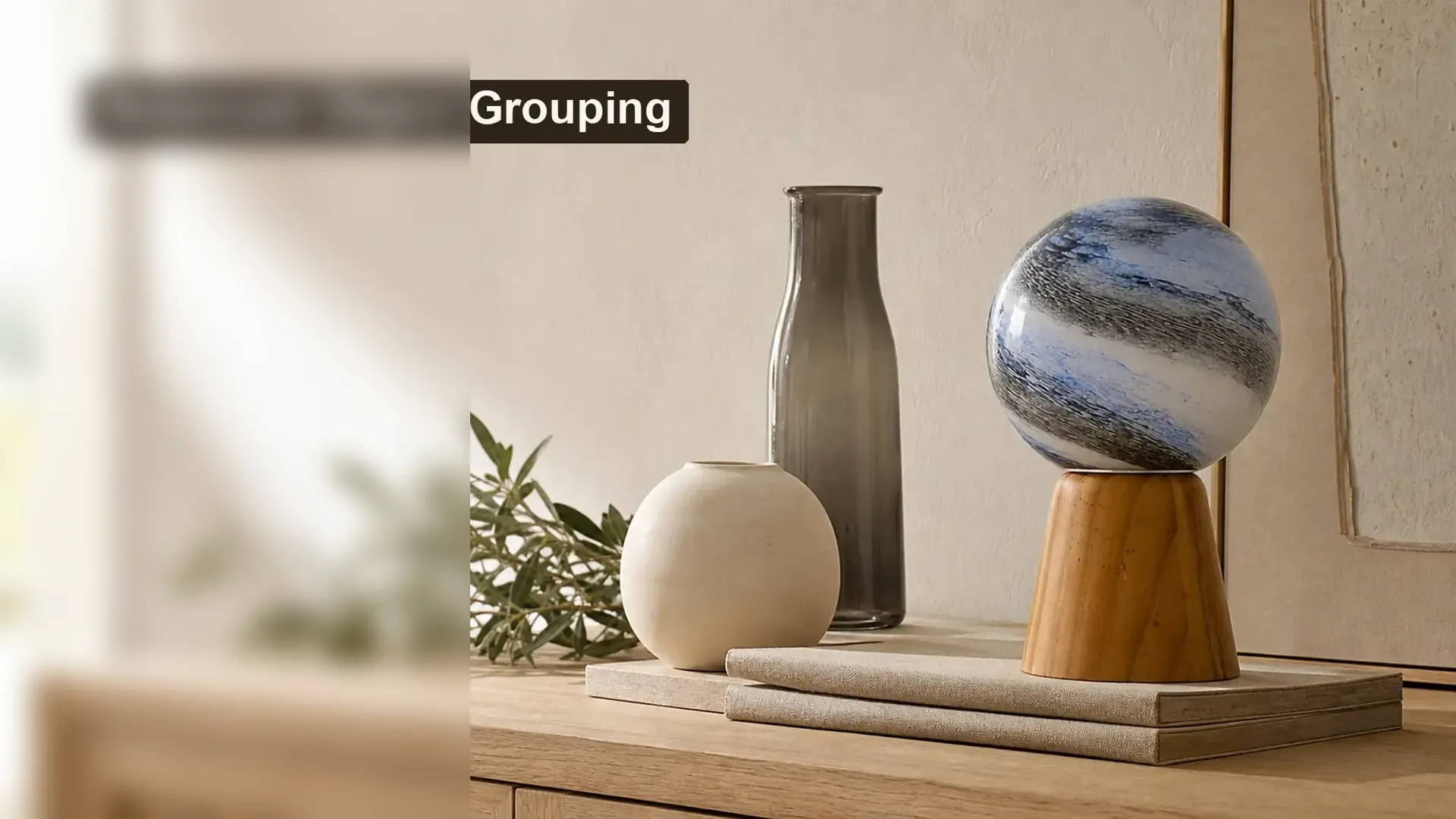
For retailers and lifestyle brands, a console display can become a small product story rather than a random assortment. Start with one anchor accessory, one lighting direction, and two quieter supporting forms. Repeat one color or surface cue across the group.
Review related JC directions such as the DSC0012 tabletop accessory, HAC04 tabletop accessory, and DSC0014 tabletop accessory. These pages are visual starting points; final dimensions, materials, finish, stability, packaging, and availability still need confirmation.
The Canadian Conservation Institute notes that ceramic and glass objects can be brittle and vulnerable to impact during handling and display1. Its preventive guidance supports stable placement and reducing unnecessary handling for vulnerable objects2. Its care note also supports conservative cleaning when decoration or surface condition is uncertain rather than aggressive treatment3. Apply these principles only where the confirmed product material and construction make them relevant.
When the collection direction is organized, use Request a Quote to share the intended market, application, product references, dimensions, finish direction, packaging needs, and unresolved questions. Contact Us can support an initial discussion. Custom options depend on product type and order requirements, so feasibility must be confirmed.
FAQ
How many objects should sit on an entryway console?
There is no fixed number. Begin with one anchor and one or two supporting objects, then protect the landing zone and remove anything that weakens the hierarchy.
Should a console display be symmetrical?
Not necessarily. Asymmetry works when the lamp, objects, and empty space have controlled visual weight.
How do I decorate a narrow console table?
Use shallow objects, limit the group width, and reserve clear depth for circulation and daily use.
Can a table lamp and decorative objects share the same console?
Yes. Compare the lamp shade width, object height, cords, switching access, and remaining usable surface.
Which colors work well in an entryway?
Use colors connected to the adjacent room, then repeat one accent rather than introducing several unrelated tones.
Can vases and tabletop accessories be mixed?
Yes, when their silhouettes and visual weight work together and their materials and functions are described accurately.
What should retailers confirm before repeating the display?
Confirm dimensions, finish, orientation, stability, care, packaging, shelf or console size, and accurate product copy.
How should fragile entryway decor be positioned?
Use a stable surface, keep vulnerable objects away from edges and heavy traffic, and follow verified handling guidance for the actual material.
Conclusion
Successful tabletop decor for entryway consoles combines a clear anchor, controlled height, restrained color connections, and protected usable space. The display should make arrival feel intentional while remaining practical for the real room or retail context.
Action checklist
- Measure the console width, depth, and main viewing directions.
- Define what the entryway must hold during normal use.
- Choose one anchor object with a clear visual role.
- Balance a lamp or tall element with a quieter accessory group.
- Repeat one color, curve, material, or finish cue.
- Complete the Entryway Console Space Map.
- Confirm product dimensions, materials, finish, stability, care, packaging, and target-market details.
- Send the organized collection brief to JC Home Decor for product-specific discussion.
References
- Canadian Conservation Institute – Ceramics and Glass – Supports careful handling and protection from impact.↩
- Canadian Conservation Institute – Preventive Care for Ceramics and Glass – Supports stable display and reduced unnecessary handling.↩
- Canadian Conservation Institute Notes 5/1 – Care of Ceramics and Glass – Supports conservative cleaning for decorated or uncertain surfaces.↩