J.C Home Decor and Lighting Manufactory

Introduction
Rechargeable lamp brightness modes affect how a portable lamp feels in real use, from soft ambience to task-adjacent accent lighting. This guide gives product developers, retail product teams, and lighting brands a conservative way to discuss dimming levels, controls, runtime expectations, and sample review without making unverified performance promises. You will get a brightness mode review sheet that can be used during product discussion and sample checking.
Define Brightness Modes Before Discussing Performance
A portable lamp should have a job before it enters a display or product plan. It may soften a shelf, mark the centre of a dining table, or demonstrate a control feature that customers need to understand. Begin with the intended setting, then decide whether the lamp should be a focal point, a supporting accent, or a practical product detail.
For a relevant product starting point, review the Rechargeable Battery Lamps category and the broader Lighting collection. Product-specific battery, charging, brightness, finish, and use information should be confirmed before final selection. The Canadian Centre for Occupational Health and Safety notes that lighting should suit the task and visual environment, including glare and shadows.That principle is useful when decorative lighting must feel comfortable in a real setting.1
Use the Brightness Mode Review Sheet
The practical tool for this article is the Brightness Mode Review Sheet. Use it before building a display, selecting a table-setting direction, or reviewing product behaviour. It turns a broad styling idea into a set of checks that can be repeated by a retail, design, or product team.
| Mode type | User expectation | Review focus | Safe wording |
|---|---|---|---|
| Single brightness | Simple operation | Whether the level suits the intended setting | Confirm actual output through product information |
| Two or three levels | Flexible mood control | Difference between low, medium, and high | Review samples in the intended context |
| Stepless dimming | More precise adjustment | Control smoothness and memory behaviour | Confirm function details before final copy |
| Touch or button control | Easy interaction | Placement, response, and accidental activation | Check the exact control design |
This tool is not a technical specification. It helps organise visual and usage questions so the final product discussion can stay clear and conservative.

Review Controls as Part of User Experience
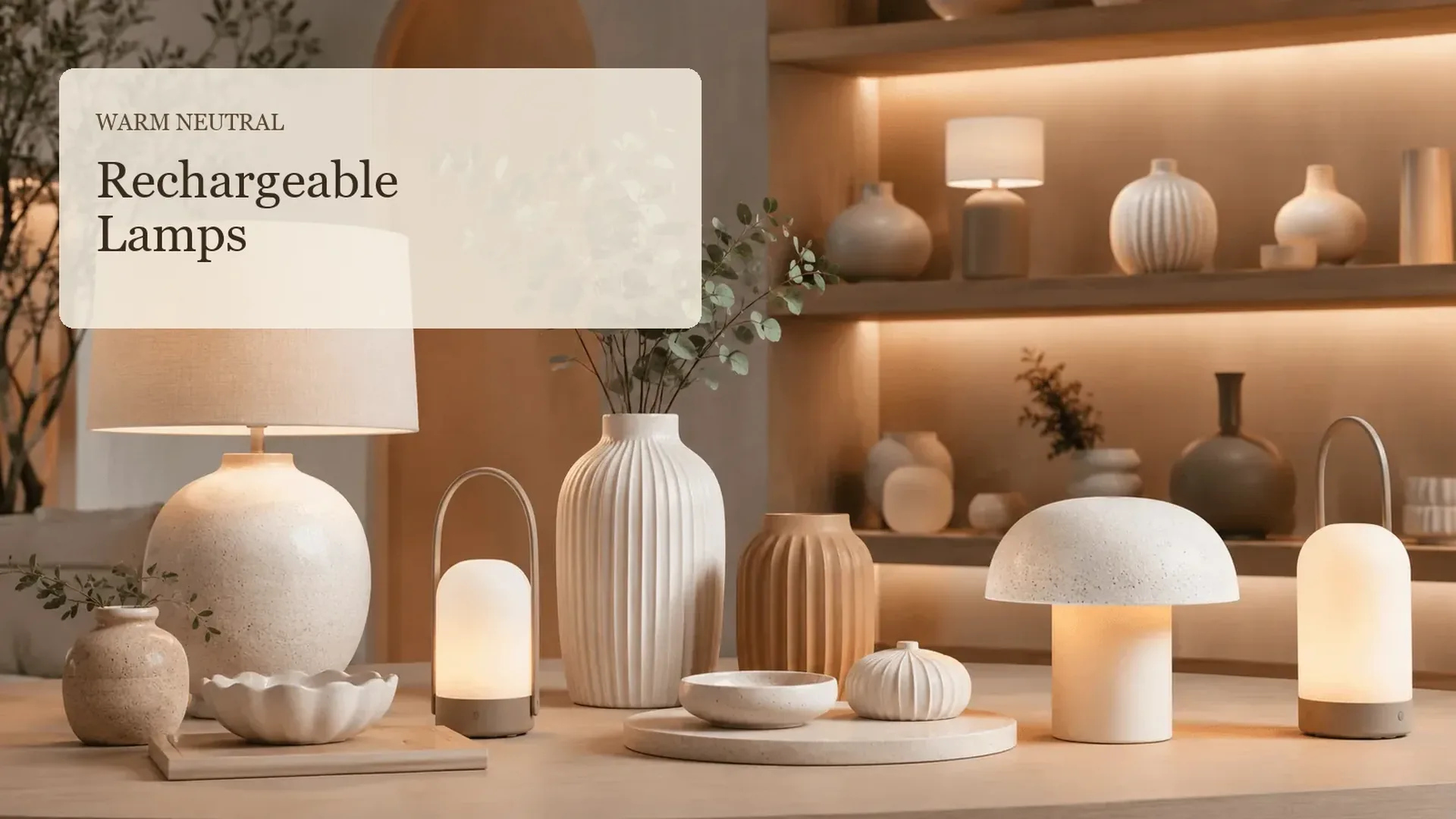
The lamp should relate to nearby products through colour, material, height, or function. A ceramic vase, a tray, a folded textile, or a small tabletop accessory can make the lamp feel part of a collection rather than a separate object. For adjacent decor directions, see Table Top Accessories and Vases.
A useful grouping has one anchor, one support, and one quiet connector. The anchor may be the lamp; the support may be a vase or object; the connector may repeat the lamp’s finish, colour, or texture. The same logic can also connect portable lamps with standard Table Lamps when a collection needs both fixed and flexible lighting directions.
A portable lamp automatically improves every display. False
A lamp can add clutter if the scale, surface, glare, or surrounding products do not support the intended story.
The best lamp role is specific. True
A clear role helps teams choose size, finish, brightness behaviour, and supporting decor with fewer assumptions.
Connect Brightness, Runtime, and Setting Carefully
Small details change how a rechargeable lamp is perceived. A matte surface may feel calm, a reflective detail may create a small highlight, and a compact base may work better in tight settings. Review the product in the intended environment instead of relying only on a white-background product image.
| Review item | Why it matters | What to ask for |
|---|---|---|
| Lowest setting | Creates ambience without harshness | Sample observation or product details |
| Highest setting | Shows practical upper range | Confirmed specification, not guesswork |
| Control action | Shapes daily use | Button, touch, hold, or switch details |
| Charging relation | Runtime may vary by setting | Supplier guidance for the exact model |

The European Commission includes colour-related information in its light-source context.For decorative lighting, this supports reviewing the appearance of light together with nearby finishes and materials.2
Charging and controls can be ignored during styling. False
A beautiful display can still fail if staff, buyers, or users cannot understand charging, controls, or intended conditions.
Samples help turn visual ideas into safer decisions. True
Samples can clarify finish, scale, brightness behaviour, and handling details before a product direction is finalised.

Apply This to Your Next Product Review
Use this action checklist before moving forward:
- Define the lamp’s main role in one sentence.
- Check the surface, surrounding objects, and visual comfort.
- Pair the lamp with one related decor category instead of many unrelated objects.
- Confirm charging, control, finish, and intended-use details for the exact product.
- Keep public copy conservative until specifications and samples are confirmed.
For broader assortment planning, browse the JC Home Decor products overview or use the contact page to discuss a product direction.
FAQ
What are brightness modes in rechargeable lamps?
Start with the intended setting and the exact product information available. Confirm dimensions, finish, charging method, controls, and visual comfort before using the lamp in final copy, display planning, or product selection.
Do more brightness levels always mean a better lamp?
Start with the intended setting and the exact product information available. Confirm dimensions, finish, charging method, controls, and visual comfort before using the lamp in final copy, display planning, or product selection.
How should low brightness be evaluated?
Start with the intended setting and the exact product information available. Confirm dimensions, finish, charging method, controls, and visual comfort before using the lamp in final copy, display planning, or product selection.
Can runtime be promised from brightness mode alone?
Start with the intended setting and the exact product information available. Confirm dimensions, finish, charging method, controls, and visual comfort before using the lamp in final copy, display planning, or product selection.
What control details should buyers review?
Start with the intended setting and the exact product information available. Confirm dimensions, finish, charging method, controls, and visual comfort before using the lamp in final copy, display planning, or product selection.
Should brightness be checked through samples?
Start with the intended setting and the exact product information available. Confirm dimensions, finish, charging method, controls, and visual comfort before using the lamp in final copy, display planning, or product selection.
What should product teams confirm before writing retail copy?
Start with the intended setting and the exact product information available. Confirm dimensions, finish, charging method, controls, and visual comfort before using the lamp in final copy, display planning, or product selection.
Conclusion
Understanding Brightness Modes in Rechargeable Table Lamps is most useful when the lamp is planned as part of a setting, not as an isolated object. Use the Brightness Mode Review Sheet to connect product role, surface, visual comfort, and practical details, then confirm the exact product information before final decisions. Explore Rechargeable Battery Lamps or request a quote when you are ready to discuss a coordinated direction. The U.S. Fire Administration advises following battery instructions and watching for unusual heat, odour, leaking, shape change, or unusual sounds in lithium-ion battery products.That is a useful reminder to treat rechargeable-product guidance conservatively.3
References
- CCOHS: Lighting Ergonomics – General – Supports lighting comfort, glare, shadows, and task-environment guidance. Back
- European Commission: Light Sources – Supports light-source information context and colour-characteristic considerations. Back
- U.S. Fire Administration: Battery Fire Safety – Supports conservative rechargeable battery handling and warning-sign guidance. Back