J.C Home Decor and Lighting Manufactory


Introduction
You need a wholesale home decor supplier that can support Europe and US retail calendars without creating constant stock pressure.
You also need supply chain optimization that connects logistics efficiency, inventory planning, production scheduling, and sourcing strategy into one workable system.
You may sell ceramic vases, table lamps, pots, tabletop accessories, or full home decor collections, but the same problem appears when product lines grow too fast.
Therefore, this guide explains how home decor brands can build a more stable wholesale supply chain with clearer planning, better supplier communication, and stronger product continuity.

What Supply Chain Optimization Means for Home Decor Brands
Supply chain optimization is the process of improving how products move from design planning to production, packing, shipping, warehouse intake, and retail replenishment. In home decor, it is not only about cheaper freight or faster delivery.
Instead, the real goal is balance. A brand must keep enough inventory for core products while avoiding excessive stock in slow-moving decorative items.
According to ASCM, supply chain management includes the design, planning, execution, control, and monitoring of activities that create value and synchronize supply with demand.synchronize supply with demand1 For home decor brands, this means the supplier relationship should support demand planning, product development, manufacturing efficiency, and repeat orders.
A reliable partner should help you answer four practical questions:
- Which products should stay as evergreen items?
- Which styles should be seasonal or limited?
- How should production batches match retail sales cycles?
- What information should be confirmed before every reorder?
JC Home Decor supports ceramic-led lighting and decor collections, including table lamps, floor lamps, rechargeable battery lamps, ceiling pendants, vases, pots, and tabletop accessories. Therefore, brands can plan product families instead of isolated SKUs.
For example, buyers can review wholesale decor collections and custom lighting options before preparing a seasonal launch plan.

Build the Supply Chain Around Product Roles
A home decor collection usually includes different product roles. Some items generate stable repeat sales, while others create seasonal freshness.
However, many brands treat every SKU the same. As a result, inventory planning becomes unclear, warehouse space becomes tight, and reorder timing becomes reactive.
A better system separates products into supply chain roles.
| Product Role | Typical Home Decor Examples | Supply Chain Priority | Planning Method |
|---|---|---|---|
| Core repeat items | Ceramic vases, neutral table lamps, simple pots | Stable replenishment | Forecast by sales history and reorder cycle |
| Seasonal accents | Holiday decor, trend colors, giftable tabletop items | Time-sensitive launch | Confirm schedule earlier and limit overstock |
| Statement pieces | Large floor lamps, sculptural vases, decorative pendants | Visual merchandising | Produce in planned batches |
| Test products | New glazes, new shapes, trial colors | Market feedback | Start with controlled quantities |
| Custom collections | Private label lamps, exclusive ceramic decor series | Design consistency | Align prototype, approval, and repeat production |
This structure helps your supplier plan materials, molds, finishing capacity, packaging, and shipment windows. Moreover, it helps your team decide which items need safety stock and which items should stay flexible.
For ceramic products, product role planning is especially useful. Glaze, color, firing variation, and hand-finishing details can affect batch consistency. Therefore, buyers should define repeat items early and keep approved references for future production.
Improve Inventory Planning Before Placing Larger Orders
Inventory planning should begin before the purchase order. In home decor, demand can shift because of seasonality, color trends, store layout, channel mix, and retail promotion timing.
Therefore, a brand should avoid planning only from last month’s sales. A more useful method combines product role, sales velocity, warehouse space, and supplier production rhythm.
| Planning Input | Why It Matters | What to Share With Your Supplier |
|---|---|---|
| Target selling season | Helps protect launch timing | Required delivery window and retail launch date |
| Product category mix | Affects packing, carton size, and container use | Ratio of lamps, vases, pots, and accessories |
| Reorder expectation | Supports material and capacity planning | Forecasted reorder quantity range |
| Packaging format | Influences warehouse handling and retail presentation | Mail-order, retail shelf, or bulk packing needs |
| Market destination | Affects labels, documents, and product details | Europe, US, or other destination market |
| Core vs seasonal items | Prevents stock imbalance | SKU role and expected lifecycle |
In addition, inventory planning should include visual assortment logic. Home decor buyers often purchase by collection, not by single product. A vase, lamp, and tabletop accessory may sell better when they share a color palette or material direction.
JC Home Decor’s ceramic-led product strategy can support this kind of coordinated assortment. Buyers can also use custom home decor and lighting solutions to align color, finish, packaging, and product family requirements before sampling.
Larger wholesale orders always create a stronger supply chain. False
Large orders can reduce unit handling work, but they may also increase storage pressure and markdown risk if product roles, sales timing, and reorder plans are unclear.
Inventory planning should separate core and seasonal products. True
Core items need continuity, while seasonal decor needs timing control. This distinction helps brands protect cash flow and avoid slow-moving stock.
Connect Production Scheduling With Retail Calendars
Production scheduling is one of the most important parts of wholesale supply chain optimization. It links your sales plan with factory capacity, material preparation, sample approval, finishing, packaging, and shipment.
However, home decor brands often send final orders too late. Then every part of the process becomes urgent.
A better approach starts with the retail calendar and works backward.
First, define the launch date. Next, confirm the warehouse arrival date. After that, calculate shipping time, packing time, production time, sample approval time, and material preparation time.
This reverse schedule gives both sides a clearer working rhythm. Moreover, it reduces the risk of changing color, size, packaging, or quantity after production has started.
For ceramic lighting and decor, scheduling should also consider surface finish approval. A small glaze difference may be acceptable for handmade character, but brand collections still need a controlled appearance. Therefore, approved samples and production references are important for repeat orders.
A Simple Production Scheduling Framework
| Stage | Buyer Responsibility | Supplier Responsibility | Risk If Ignored |
|---|---|---|---|
| Product brief | Share style, size, material, target market | Confirm feasibility and development route | Unclear sampling direction |
| Sample approval | Review shape, finish, function, packaging | Adjust details and keep reference records | Repeated revisions |
| Order confirmation | Confirm quantity, SKU mix, labels, cartons | Plan materials and production capacity | Delayed batch start |
| Production control | Avoid late changes | Monitor batch consistency | Quality variation |
| Packing preparation | Confirm retail or export packing needs | Prepare carton, insert, and label details | Warehouse or transit issues |
| Shipment coordination | Align forwarder and documents | Support loading and export documents | Customs or delivery delay |
This framework does not require complex software. Instead, it requires disciplined communication. Even a shared planning sheet can improve manufacturing efficiency when both sides update it regularly.
Use Logistics Efficiency as a Planning Tool
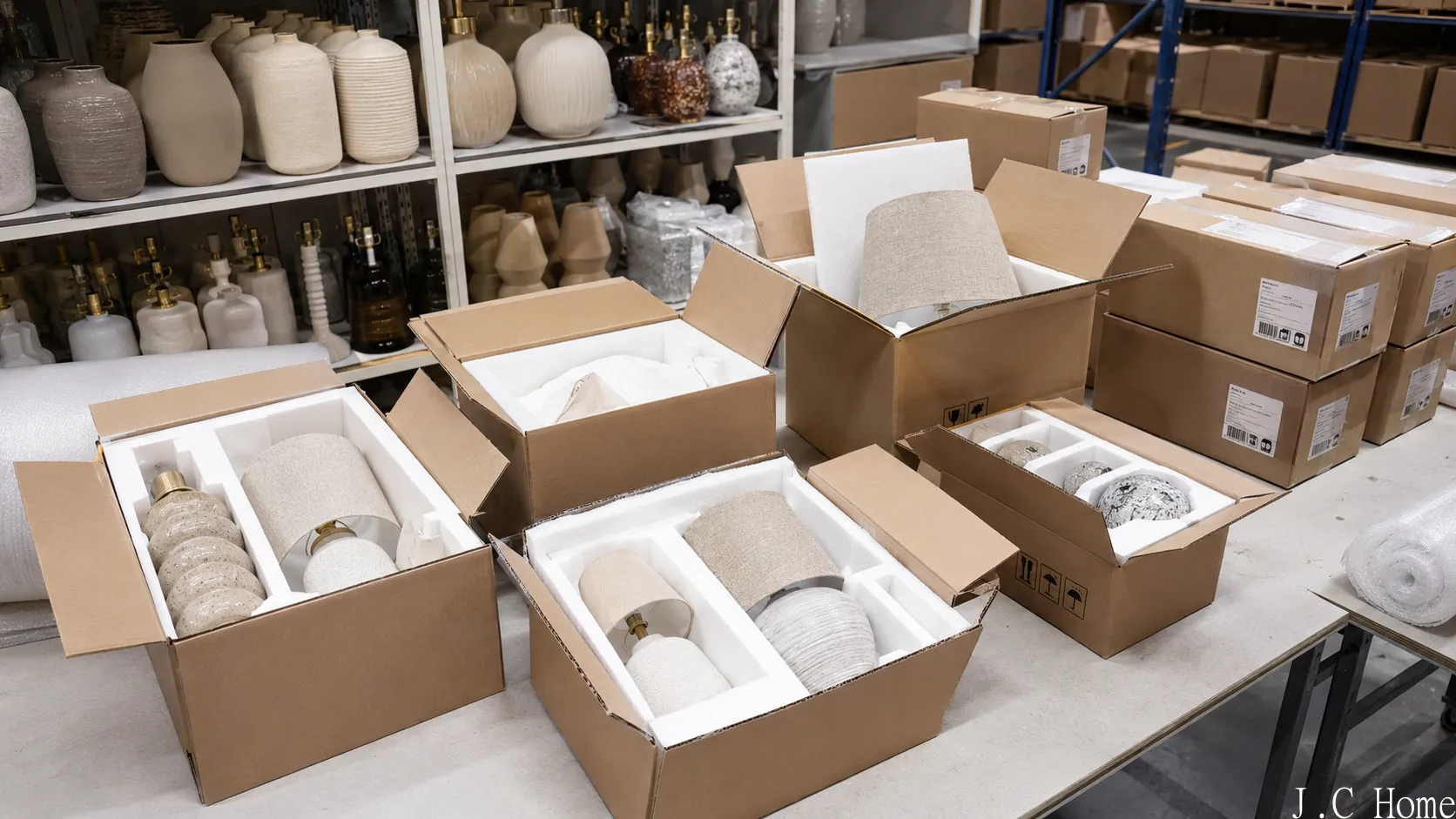
Logistics efficiency should not start after production. It should influence product planning, carton design, packing method, and shipment consolidation from the beginning.
For example, decorative lamps may need more protective packaging than simple tabletop accessories. Ceramic vases may require internal protection and stable carton structure. Meanwhile, mixed collections may need carton marks that help warehouse teams identify SKUs faster.
The World Trade Organization’s Trade Facilitation Agreement focuses on expediting the movement, release, and clearance of goods, including goods in transit.movement, release, and clearance of goods2 Although brands cannot control every customs factor, they can reduce avoidable delays through complete documentation, clear product information, and organized shipment planning.
For wholesale home decor brands, logistics efficiency usually improves when these details are confirmed early:
- Carton size and packing method
- Product description and material information
- SKU labels and carton marks
- Inner protection for fragile items
- Mixed container or consolidated shipment plan
- Warehouse intake requirements
- Retail-ready packaging needs
In addition, brands should review whether packaging supports both protection and retail presentation. A strong carton protects the product, but a clear brand packaging system also helps retailers handle receiving, storage, and shelf preparation.
Improve Visibility With Better Product Data
Supply chain optimization depends on data visibility. If the supplier, importer, warehouse, and retail team all use different product names or incomplete SKU details, mistakes become more likely.
Therefore, each product should have consistent data from sample development to shipment.
GS1 explains that standardized product identification helps products become easier to find, buy, trace, and fulfill across supply chains.standardized product identification3 For home decor brands, this does not only apply to barcodes. It also supports clearer inventory control and warehouse communication.
A practical product data sheet should include:
| Data Field | Example Information | Why It Helps |
|---|---|---|
| SKU code | Internal item number | Prevents product confusion |
| Product name | Ceramic vase, rechargeable table lamp, decorative pot | Supports warehouse and sales teams |
| Dimensions | Product size and carton size | Helps storage and freight planning |
| Material | Ceramic, metal, fabric shade, glass, or mixed material | Supports product classification |
| Finish | Glaze, matte, textured, hand-painted, metallic detail | Protects visual consistency |
| Packaging | Inner box, master carton, retail box | Improves receiving and display planning |
| Market notes | EU or US requirements to confirm | Reduces last-minute checking |
| Reorder status | Core, seasonal, discontinued, test item | Supports replenishment decisions |
Moreover, product data should remain consistent across quotation sheets, sample labels, order files, packing lists, and warehouse records.
Logistics efficiency only depends on freight forwarders. False
Forwarders matter, but product data, carton structure, SKU labels, packing accuracy, and document preparation also affect delivery speed and warehouse handling.
Clear SKU data improves reorder accuracy. True
When product names, materials, finishes, and packaging details stay consistent, brands can reorder faster and reduce avoidable communication mistakes.
Align Sourcing Strategy With Long-Term Supply
A sourcing strategy should not only ask, “Where can I buy this product?” It should also ask, “Can this product line stay stable across seasons?”
This matters because home decor brands need both freshness and continuity. Newness attracts buyers, while stable replenishment protects retail performance.
Therefore, a practical sourcing strategy should include three layers.
1. Product Line Continuity
Choose a supplier that can support repeatable shapes, finishes, and product families. For ceramic decor, this may include stable molds, approved glaze references, and coordinated color development.
2. Assortment Flexibility
A brand may need vases, table lamps, pots, and tabletop accessories in one collection. In this case, a supplier with connected product categories can reduce communication work and improve visual consistency.
3. Development Support
Long-term supply is easier when the supplier understands sampling, customization, packaging, and batch consistency. Instead of changing suppliers for every launch, brands can build a repeatable workflow.
JC Home Decor’s product range covers both lighting categories and decor categories, which can help brands create coordinated assortments for retail, wholesale, and interior channels.
A Practical Optimization Checklist
Before your next wholesale home decor order, use this checklist to review whether your supply chain is ready.
| Optimization Area | Key Question | Stronger Practice |
|---|---|---|
| Product planning | Are SKUs classified by role? | Separate core, seasonal, test, and custom items |
| Inventory planning | Is reorder timing visible? | Share forecast ranges instead of only urgent orders |
| Production scheduling | Are approvals completed early? | Confirm samples, colors, labels, and packaging before batch start |
| Logistics efficiency | Is packing planned with shipment needs? | Align carton structure, marks, and warehouse intake requirements |
| Data visibility | Are product details consistent? | Use one product data sheet across all order documents |
| Sourcing strategy | Can the supplier support repeat collections? | Build a long-term product family workflow |
| Communication | Are changes tracked clearly? | Keep written records for design, packaging, and order updates |
This checklist is simple, but it can prevent many avoidable problems. Also, it helps your supplier understand which details affect your sales channel.
For brands preparing a new collection, it is useful to share product references, target market, expected launch window, packaging requirements, and reorder expectations when contacting JC Home Decor.
When to Optimize Before Scaling
A brand should optimize the supply chain before expanding SKU count too quickly. Otherwise, growth can create hidden pressure.
For example, a catalog may look attractive with more products, but the warehouse may struggle with slow-moving variations. Likewise, a large custom collection may improve brand identity, but it needs better sample control and production records.
Therefore, optimization should happen before these situations:
- Expanding from single products to full collections
- Moving from trial orders to repeat wholesale supply
- Adding private label packaging
- Entering new Europe or US retail channels
- Combining lighting and decor in one seasonal launch
- Increasing order quantities across multiple SKUs
- Coordinating container shipment or mixed-category delivery
In these cases, supplier communication should become more structured. Buyers should not only request prices. Instead, they should share planning context.
A helpful inquiry includes product category, style direction, quantity range, target market, expected delivery window, packaging needs, and whether the product is core, seasonal, or custom.
You can learn more about JC Home Decor’s factory background through the About Us page or send project details through the Contact Us page.
FAQ
What does supply chain optimization mean for home decor brands?
Supply chain optimization means improving how products are planned, produced, packed, shipped, stored, and replenished. For home decor brands, it should connect inventory planning, production scheduling, logistics efficiency, and sourcing strategy.
How can a wholesale home decor supplier improve inventory planning?
A wholesale home decor supplier can help by separating core items, seasonal items, test products, and custom collections. This structure makes reorder timing clearer and helps the supplier prepare materials, capacity, and packaging more efficiently.
Why is production scheduling important for ceramic decor and lighting?
Production scheduling matters because ceramic products often require shape approval, finish confirmation, firing control, packing preparation, and batch consistency checks. Early scheduling reduces rushed changes and supports more stable repeat production.
How can brands reduce logistics problems for fragile home decor products?
Brands can reduce logistics problems by confirming carton structure, inner protection, SKU labels, carton marks, and warehouse intake requirements before production ends. In addition, clear product descriptions and documents help avoid unnecessary shipment confusion.
Should home decor brands use one supplier for lighting and decor?
Using one connected supplier can help when the brand wants coordinated collections across lamps, vases, pots, and tabletop accessories. However, buyers should still confirm product capability, quality control process, customization details, and packaging requirements.
What information should buyers send before requesting a quote?
Buyers should send product type, target quantity, size, material preference, finish direction, target market, packaging needs, delivery window, and whether the product is for core replenishment or seasonal launch. This helps the supplier give a more accurate response.
Is the lowest unit price the main goal of supply chain optimization?
No. A low unit price can become expensive if it creates high defect risk, poor packaging, delayed replenishment, or excess inventory. A stronger system balances cost, consistency, timing, and long-term product continuity.
Conclusion
A stronger wholesale home decor supply chain does not come from one single improvement. Instead, it comes from better coordination between product roles, inventory planning, production scheduling, logistics efficiency, product data, and sourcing strategy.
For home decor brands, this approach protects both creativity and continuity. It allows new seasonal products to launch with structure, while core products remain easier to replenish.
JC Home Decor supports ceramic-led lighting and decor collections for brands, importers, retailers, wholesalers, and design-related partners. To prepare a more efficient supply plan, review the decor collection category, explore lighting products, or contact JC Home Decor with your product category, target market, quantity range, packaging needs, and expected launch schedule.
References
-
ASCM — Supply Chain Management Definition — Supports the explanation of supply chain management as planning, execution, control, monitoring, and demand-supply synchronization.
↩ -
World Trade Organization — Trade Facilitation — Supports the logistics section on movement, release, and clearance of goods in international trade.
↩ -
GS1 US — Barcodes Powered by GS1 Standards — Supports the discussion of standardized product identification, traceability, fulfillment, and supply chain visibility.
↩
Buyer Checklist Before Requesting a Quote
| Information to Prepare | Why It Helps |
|---|---|
| Product category and target use | Helps confirm the right lighting or decor direction. |
| Target market | Supports electrical, packaging, labeling, and document discussion. |
| Material, color, and finish direction | Reduces misunderstanding during sample communication. |
| Packaging and label needs | Important for fragile products and retail-ready planning. |
| Reference images or collection mood | Helps align design language before quotation. |
Clear buyer information helps reduce misunderstanding before sample and order communication.