J.C Home Decor and Lighting Manufactory


Introduction
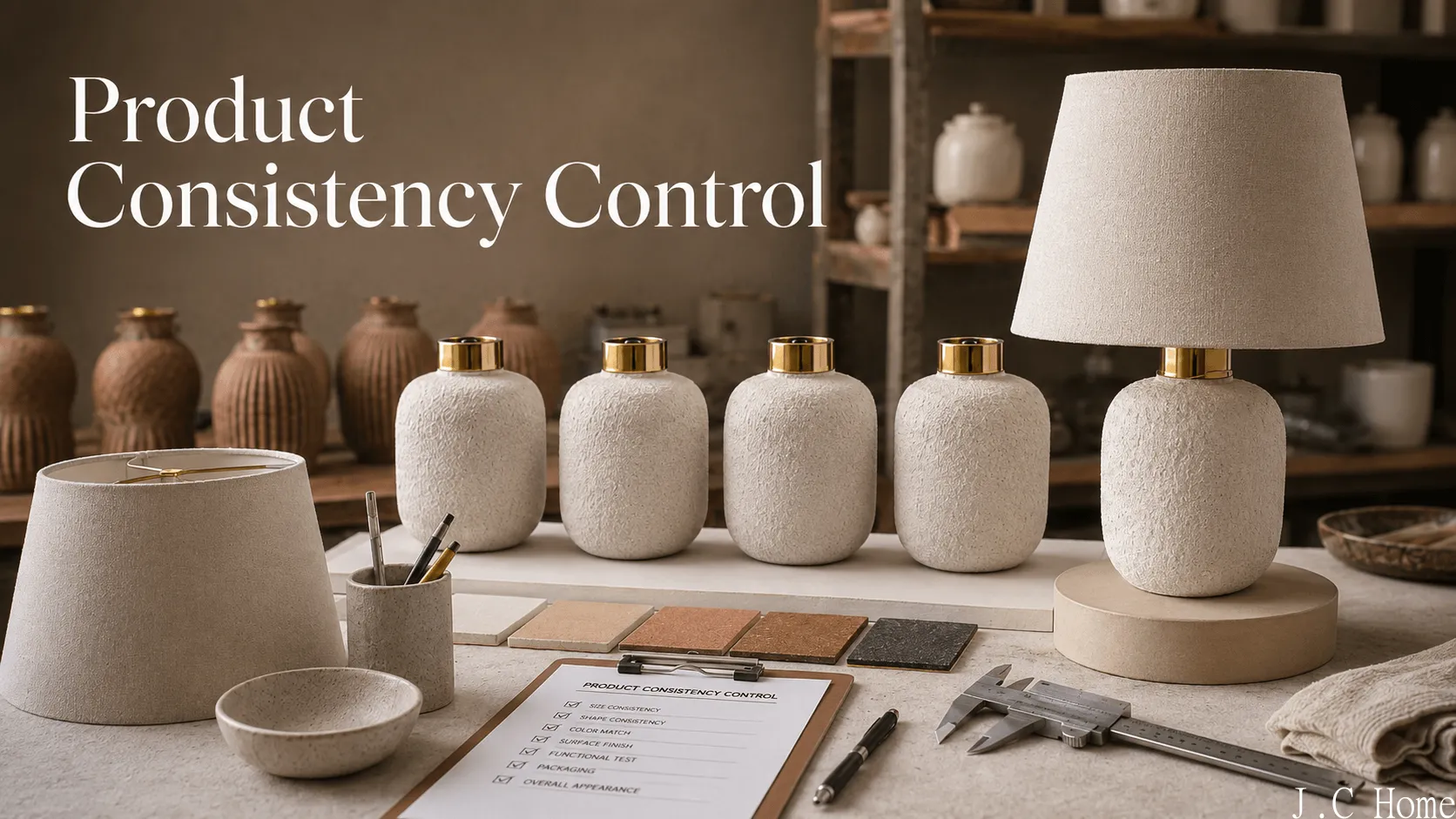
You need a ceramic table lamp manufacturer that can keep shape, glaze, color, shade fit, and packaging consistent across repeat orders. For Europe and the United States, you also need quality records that help your team review batches, manage product variance, and confirm lighting details before launch. Because ceramic manufacturing involves firing, glazing, assembly, and packing, consistency depends on a controlled system rather than one final inspection. In this article, you will learn how quality consistency, batch control, and defect management work inside a ceramic manufacturing system.
For product direction, you can review JC Home Decor’s Table Lamps collection before preparing your quality brief.
Why Ceramic Table Lamp Consistency Is Different
Ceramic table lamps are not like fully machined metal parts. Clay body, mold condition, drying time, glaze behavior, kiln loading, shade assembly, and carton protection can all affect the final result.
However, natural ceramic variation does not mean uncontrolled variation. A professional QC system defines what can vary, what must stay fixed, and what requires correction before shipment.
For example, a reactive glaze may have a controlled color range. Meanwhile, lamp height, base stability, shade alignment, wiring details, and carton labeling should follow stricter checkpoints.
Therefore, consistency control starts before mass production. It begins with approved samples, measurable specifications, batch records, and inspection criteria.

The Main Sources of Production Variance
Production variance usually comes from several small changes, not one obvious mistake. In ceramic lighting, these changes often appear in shape, surface, color, assembly, and packing.
| Production Area | Common Variance | Control Method | Buyer Impact |
|---|---|---|---|
| Clay body and forming | Shrinkage, slight shape difference, uneven wall thickness | Mold records, forming checks, controlled drying | Better silhouette consistency |
| Glazing | Color shift, gloss variation, pinholes, uneven coverage | Approved sample range, glaze formula control, surface limit samples | More predictable retail display |
| Firing | Warping, glaze flow, tone variation | Kiln temperature records, loading pattern control | Lower batch mismatch |
| Assembly | Shade tilt, loose fitting, unstable base | Assembly jig, torque check, balance check | Safer and cleaner product presentation |
| Packing | Breakage, carton confusion, wrong label | Packing test logic, carton checklist, SKU version control | Fewer warehouse and retail issues |
Because each point affects the final product, a strong ceramic table lamp manufacturer should control the process step by step. This approach also matches the idea of a process approach in quality management1, where connected activities are managed to achieve intended results.
A good sample always means stable mass production. False
A sample confirms design direction, but mass production needs process controls, approved tolerance ranges, batch records, and inspection checkpoints to reduce unwanted variation.
Ceramic variation can be managed with clear limits. True
Ceramic surfaces may show natural differences, but buyers and manufacturers can define acceptable color, gloss, texture, and defect limits before production.

Batch Control From Sample to Shipment
Batch control connects the approved sample with the final shipment. Without this connection, each production run may drift from the original style direction.
A practical batch control system should answer four questions. What was approved? Which details changed? Who checked it? Which batch does this carton belong to?
This is why production records matter. They help the factory compare current output with approved references and identify problems before the goods move too far down the line.
NIST explains that statistical process control compares current process performance with previous performance to signal when corrective action may be needed.2 In ceramic lamp production, this logic can support checks for dimensions, shade fit, surface defects, and repeated assembly issues.
A Practical Batch Control Checklist
| Stage | What to Record | Why It Matters | Typical Decision |
|---|---|---|---|
| Pre-production sample | Shape, size, finish, shade, hardware, packaging | Creates the reference standard | Approve, revise, or resample |
| Material preparation | Clay body, glaze batch, accessory version | Reduces unexpected visual changes | Continue or adjust |
| First-piece inspection | First finished lamp from production | Finds drift before full output | Release or correct |
| In-process inspection | Random checks during forming, glazing, firing, assembly | Catches recurring defects early | Isolate and repair |
| Final inspection | Appearance, structure, packing, labels, quantity | Confirms shipment readiness | Ship, rework, or hold |
| Batch traceability | Lot code, carton mark, SKU version | Supports reorder and claim analysis | Archive for future orders |
For custom programs, buyers can also discuss finish ranges and repeat order planning through JC Home Decor’s custom home decor and lighting solutions.
QC System Design for Ceramic Lamp Production
A QC system should not depend on memory or personal judgment alone. Instead, it should turn product expectations into visible checkpoints.
First, the factory should define the standard. This includes approved samples, drawings, dimensions, shade details, finish references, electrical details, and packing instructions.
Next, the production team should confirm the control points. In ceramic table lamps, these points often include molding, drying, glazing, firing, drilling, assembly, cleaning, labeling, and packing.
Then, inspection teams should use clear defect categories. Critical defects may affect safety or function. Major defects may affect appearance, stability, or customer acceptance. Minor defects may fall within an agreed range if they do not affect use or presentation.
Finally, corrective action should feed back into production. If shade tilt appears repeatedly, the issue may come from assembly method, hardware tolerance, or base angle. Checking only the finished lamp may not solve the root cause.

Defect Management: What Should Be Classified
Defect management is not only about rejecting products. It is a system for describing problems, finding causes, and preventing repeat issues.
In ceramic manufacturing, some defects are visual. Others are structural or functional. For lamps, assembly and electrical details also matter because the product combines ceramic decor with lighting components.
| Defect Type | Example | Risk Level | Better Management Method |
|---|---|---|---|
| Surface defect | Pinholes, glaze spots, scratches | Minor to major | Use agreed surface limit samples |
| Color variance | Batch tone differs from approval | Major if visible in one display | Compare under consistent lighting |
| Shape issue | Warped body, uneven base | Major | Check forming, drying, and firing |
| Assembly issue | Shade leaning, loose holder | Major | Use assembly fixture and balance check |
| Functional issue | Switch, socket, cable, battery issue | Critical or major | Confirm relevant electrical requirements |
| Packing issue | Weak protection, wrong carton label | Major | Use packing checklist and carton version control |
For lighting products, manufacturers and buyers should confirm applicable market requirements. IEC 60598-1 covers general requirements for luminaires up to 1,000 V, including areas such as classification, marking, mechanical construction, and electrical construction.4 However, buyers should verify the exact requirements for each target market and product configuration.
Final inspection alone can control ceramic lamp quality. False
Final inspection can find visible problems, but it cannot fully prevent repeated defects caused by forming, glazing, firing, assembly, or packing errors.
Defect records improve repeat order stability. True
When defect causes are recorded by batch, the manufacturer can adjust process controls and help future orders match the approved standard more closely.
Inspection Sampling and Batch Decisions
Not every product can always be inspected in the same way. For this reason, buyers and manufacturers often use sampling plans for batch decisions.
ASQ describes ANSI/ASQ Z1.4 as an acceptance sampling system for inspection by attributes with switching rules.3 In practice, this type of thinking helps teams decide how many units to inspect and how to treat defects by category.
However, sampling should not replace process control. It works better when the production process already has stable checkpoints.
For ceramic table lamps, sampling can cover appearance, dimensions, balance, shade fit, carton marking, and packaging condition. Meanwhile, functional and market-related checks should follow the product’s technical requirements.
Managing Natural Ceramic Variation
Ceramic lamps often gain value from handmade texture, glaze movement, and depth of finish. Therefore, buyers should not demand unrealistic sameness when the design uses reactive glaze or textured ceramic surfaces.
Still, the range must be controlled. A manufacturer can use reference samples, color cards, signed photos, and written defect limits to define what is acceptable.
For example, a speckled beige glaze may allow small tone differences. However, a retail collection may not accept one carton with warm beige and another with gray beige if both appear on the same shelf.
In this case, consistency control should include batch grouping. Products with similar tone can be packed together, and obvious outliers can be separated before shipment.
What Buyers Should Prepare Before Production
Buyers can improve consistency before the order starts. Clear input reduces guesswork and helps the manufacturer build a practical QC plan.
A useful brief should include target market, product size, ceramic finish, shade material, plug or electrical direction, packaging needs, carton label rules, and repeat order expectations.
| Buyer Requirement | Why It Helps Consistency | Suggested Format |
|---|---|---|
| Approved physical sample | Reduces misunderstanding about shape and finish | Signed sample or sealed reference |
| Color and surface range | Defines acceptable ceramic variation | Color chips, photos, defect boards |
| Dimension tolerance | Controls size and assembly fit | Drawing or specification sheet |
| Shade and hardware details | Prevents mismatch during assembly | Accessory list and sample |
| Packing requirements | Reduces transit and warehouse issues | Carton diagram and label file |
| Reorder plan | Helps maintain version control | SKU list and expected repeat cycle |
If your team is preparing a custom lamp collection, you can compare JC Home Decor’s About Us page for factory background and then send your project details through the Contact Us page.
How JC Home Decor Supports Consistency Discussion
JC Home Decor focuses on ceramic-led home decor and lighting collections. Ceramic table lamps are part of this product direction, while related decor categories can support coordinated retail or project collections.
For consistency planning, buyers can discuss product style, finish direction, lamp shade details, packaging, logo needs, and target market requirements. Because each custom request may affect production control, early discussion helps the team identify key risk points before sampling.
In addition, buyers who plan ceramic decor together with lamps may review the custom ceramic decor manufacturer guide. It can help connect ceramic surface control, product development, and collection planning.
FAQ
What does product consistency mean for ceramic table lamps?
Product consistency means that shape, size, color range, glaze effect, shade fit, structure, labeling, and packing stay within agreed limits. It does not always mean every ceramic surface looks identical.
Why do ceramic lamps have more variation than metal lamps?
Ceramic lamps go through forming, drying, glazing, and firing. As a result, clay shrinkage, glaze movement, kiln conditions, and hand-finishing can create natural variation.
How can buyers control glaze color differences?
Buyers should approve a physical sample, define an acceptable color range, and review production pieces under consistent lighting. Moreover, extreme outliers should be separated before packing.
Is final inspection enough for batch control?
Final inspection helps, but it is not enough by itself. A stronger QC system checks the product during material preparation, first-piece approval, in-process production, assembly, and final packing.
What defects matter most in ceramic table lamp production?
Critical defects usually involve function or safety. Major defects may include unstable bases, shade tilt, obvious color mismatch, wrong accessories, weak packing, or incorrect labels.
How should importers prepare a quality brief?
Importers should provide product photos, target dimensions, finish references, shade details, market requirements, packaging instructions, label rules, and expected reorder needs. Therefore, the factory can plan inspection points more accurately.
Can ceramic variation be part of the design?
Yes, ceramic variation can support a natural and crafted look. However, the acceptable range should be defined before production so the final batch still feels visually coherent.
When should buyers discuss defect limits?
Defect limits should be discussed before mass production. Once the approved sample, surface range, and inspection standard are clear, batch decisions become easier.
Conclusion
Product consistency control in ceramic manufacturing systems depends on clear standards, process checkpoints, batch records, and practical defect management. A reliable ceramic table lamp manufacturer should not rely only on final inspection, because many consistency issues begin earlier in forming, glazing, firing, assembly, or packing.
For brands, importers, retailers, and design partners, the next step is to prepare a detailed quality brief before sampling. Include the product style, finish range, dimensions, shade direction, packaging needs, target market, and repeat order plan.
To plan a consistent ceramic lighting collection, explore JC Home Decor’s Table Lamps category or send your requirements through the Contact Us page.
References
-
ISO 9001:2015 Process Approach — Supports the idea that connected processes and checks help deliver intended quality outcomes.
↩ -
NIST/SEMATECH Engineering Statistics Handbook — Supports process and product monitoring principles used in statistical process control.
↩ -
ASQ/ANSI Quality Standards Z1.4 & Z1.9 — Supports acceptance sampling concepts for inspection by attributes.
↩ -
IECEE IEC 60598-1:2020 — Supports general luminaire requirement references for lighting products.
↩
Buyer Checklist Before Requesting a Quote
| Information to Prepare | Why It Helps |
|---|---|
| Product category and target use | Helps confirm the right lighting or decor direction. |
| Target market | Supports electrical, packaging, labeling, and document discussion. |
| Material, color, and finish direction | Reduces misunderstanding during sample communication. |
| Packaging and label needs | Important for fragile products and retail-ready planning. |
| Reference images or collection mood | Helps align design language before quotation. |
Clear buyer information helps reduce misunderstanding before sample and order communication.